
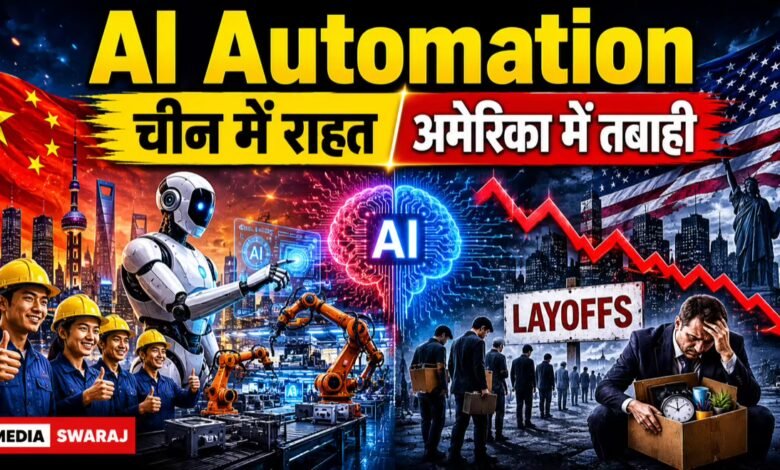
By MediaSwaraj Desk | May 2026
A historic judicial divide has opened between the world’s two largest technology powers over a question that will define the global economy for decades: can a company fire human workers simply because artificial intelligence has made them cheaper to replace?
The answer, it turns out, depends entirely on which side of the Pacific you are standing on.
The Hangzhou Precedent: A Court Draws a Red Line
In a landmark ruling that has reverberated from Beijing to Brussels, the Hangzhou Intermediate People’s Court in eastern China declared: deploying better software is not a legal justification for dismissing a human worker.
The case centred on Zhou, a 35-year-old quality assurance supervisor employed at an unnamed financial technology firm. Zhou’s job was to work directly with the company’s artificial intelligence large language models — monitoring outputs, filtering sensitive content, and verifying accuracy. He earned 25,000 yuan per month (approximately $43,900 per year).
In 2024, the company concluded its AI systems had improved enough to automate Zhou’s role. Rather than terminating him outright, management offered a reassignment to a lower-level operations post — with a 40 percent salary reduction. Zhou refused. The company then ended his contract, citing ‘organisational restructuring due to technological upgrades.’
Zhou took his employer to arbitration and won. The company challenged the ruling at a district court — and lost. It appealed to the Hangzhou Intermediate People’s Court. It lost again.
The court found the termination entirely illegal under China’s Labour Contract Law. That law permits unilateral dismissal only when a ‘major change in objective circumstances’ has occurred — a threshold reserved for events such as natural disasters, corporate bankruptcies, or government-mandated relocations.
Choosing to adopt a more capable AI model, the court ruled, is a deliberate business strategy, not an unforeseeable external crisis. The financial risk of that decision cannot be transferred to the worker.
A Second Case Confirms the Pattern
The Hangzhou ruling was not isolated. On December 26, 2025, the Beijing Municipal Human Resources and Social Security Bureau had already highlighted a parallel case involving a worker named Liu, employed since 2009 in manual map data entry.
When his company switched to AI-based data collection in early 2024, Liu’s entire division was eliminated. He was dismissed in late 2024. He won his arbitration compensation.
Two cases, two cities, the same judicial logic: AI adoption is a business choice, and the burden of that choice rests with the employer.
What Chinese Law Now Requires of Employers
If a Chinese company deploys AI in ways that affect workers, the courts have effectively established a three-step sequence before any termination can be considered lawful:
• Mandatory consultation with affected staff about the nature and scope of the technological change
• Employer-funded retraining and upskilling so that workers can operate alongside the new systems
• Reasonable reassignment to alternative roles — without punitive pay cuts designed to force resignation
The Hangzhou court added a further point: even when reassignment is offered, a 40 percent pay cut does not constitute a reasonable alternative.
The American Contrast: At-Will Employment Meets the AI Age
Across the Pacific, the picture is starkly different.In the first five months of 2026, more than 144,000 technology workers in the United States have lost their jobs — a pace that workforce analytics firm TrueUp projects could reach 370,000 by year’s end, exceeding even the severe correction of 2023.
Career services firm Challenger, Gray & Christmas has directly attributed 49,135 of those cuts to AI adoption.
The companies driving these numbers are not struggling enterprises. Meta reported first-quarter 2026 revenue of $56.3 billion — up 33 percent year on year — and then announced 8,000 job cuts in May, explicitly to offset AI infrastructure costs.
Oracle eliminated between 20,000 and 30,000 positions. Cisco cut approximately 4,000 workers, with its chief executive openly stating the reductions were driven by AI investment. Intuit cut 3,000 employees — 17 percent of its global workforce. Block, the payments company, reduced headcount from 10,000 to 6,000, citing growing AI capabilities.
Under America’s at-will employment doctrine, these companies face no domestic judicial constraint equivalent to China’s Labour Contract Law.
There is no mandatory consultation, no retraining obligation, no requirement that alternatives be offered before termination. Wall Street has largely rewarded such announcements with rising share prices, treating headcount reduction as evidence of efficiency.
The only notable policy response so far has come from California, where Governor Gavin Newsom on May 21, 2026 signed an executive order directing state agencies to study AI-driven worker displacement. No binding federal protection for affected workers exists.
Who Bears the Cost of Progress?
The contrast is not a legal technicality. It reflects two profoundly different answers to the same political question: when automation generates profit by eliminating human labour, who should absorb the social cost of that displacement?
In China, the judiciary — sensitive to middle-class anxiety and rising youth unemployment — has answered that question in favour of the worker. Scholars note this also serves a political purpose: it redirects public frustration at ‘rule-breaking corporations’ rather than at state economic policy.
The approach is not without critics within China. Pan Helin, an economist and member of an expert committee under China’s Ministry of Industry and Information Technology, has argued that while AI-driven displacement may be inevitable over time, companies must ensure fair treatment during transitions, including reasonable reassignment and adequate severance.
In the United States, the dominant assumption remains that the market — not the courts — should determine how the gains from automation are distributed.
The implicit bet is that displaced workers will find new roles in an expanding economy, and that regulatory constraints will slow innovation at a moment of intense global competition.
Goldman Sachs researchers noted in a 2025 report that it is still early days for AI adoption and that the employment impact will depend significantly on how employers ultimately deploy the technology.
The Experiment Has Begun
Whether China’s judicial framework will slow its AI sector’s global competitiveness, or whether America’s unregulated displacement will generate a social backlash its institutions struggle to manage — these questions will be answered over years, not months.
What is already clear: the global AI race is also a contest over the shape of the labour market it will leave behind. Two of the world’s most powerful economies are running that experiment on live populations, with entirely different rules.
Indian workers are also facing job losses due to deployment of AI tools . Though in principle law gives some protection to workers , but in practice workers in India don’t get any relief like China from courts .
Please listen this conversation between senior journalist Ram Dutt Tripathi and tech guru Sam Pitroda on different aspects of AI