By Siby K. Joseph, Sevagram , Wardha
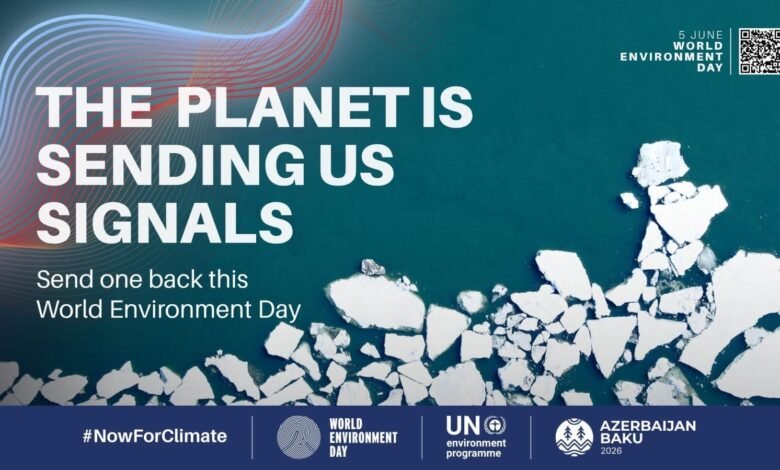
“The planet doesn’t argue. It doesn’t negotiate. It sends signals—rising seas, raging wildfires, heatwaves, melting glaciers. We said 1.5°C was the limit. We are crossing it.” This powerful statement is the official rallying cry of the United Nations Environment Programme (UNEP) for World Environment Day 2026.
This quote cuts through the noise of delay and denial, focusing sharply on the stark reality of our climate crisis. Under the Paris Agreement, nations collectively agreed to limit global warming to 1.5°C above pre-industrial levels; this warning reminds us how close we are to failing. According to UNEP, “for decades, the world has heard the climate story—warnings, targets, distant deadlines.
Too often, the response has been clouded by noise: delay, distraction, denial.” Consequently, the critical question is no longer whether change will come, but how we guide it and how fast we act.
Climate change is an undeniable global reality. It severely impacts even regions with minimal industrial development due to historical imbalances. For instance, the effects of climate change recently peaked in the Wardha district of Maharashtra, India—home to Mahatma Gandhi’s famous Sevagram Ashram—where temperatures crossed a grueling 47°C, resulting in tragic heatstroke fatalities. This is far from an isolated incident.
Amidst the scorching heat of the Vidarbha region, a concerned citizen issued a poignant appeal to the people of Wardha:
“Seeing today’s temperature in Wardha city reminded me of the tree I planted. When I look at how urgently our city and district need more trees to create an environment conducive to humans and animals, it becomes clear that planting a tree does not just solve the problem of rising temperatures—it protects our future, nature, and indirectly, all living beings.
This is not only for your own well-being but for the collective good of society, our security, and future generations. Our motherland has given us such beautiful nature; it is our duty to protect it. Plant a tree, save a life! Let’s build more greenery, cooler spaces, and a better future!”
The core of the issue is that humanity tends to think about environmental protection only during crises or on special occasions. We can only truly address this challenge when environmental consciousness becomes an active part of our daily lives and choices.
On June 5, 2026, the Republic of Azerbaijan is hosting the global commemoration of World Environment Day in its capital, Baku. Located at the crossroads of East and West along the historic Silk Road, this former Soviet republic boasts remarkable natural diversity. Its landscape spans subtropical and temperate zones, encompassing eight distinct climate types ranging from lush subtropical forests to alpine ecosystems, creating a rich cradle of biodiversity.
Azerbaijan is rapidly pursuing green growth and renewable energy. As a party to the Paris Agreement, it has committed to reducing its greenhouse gas emissions by 40% by 2035 (compared to 1990 levels) and aims to increase its renewable energy share to 30% by 2030 through large-scale projects.
Furthermore, as the host of COP29, Azerbaijan continues to advance the global climate agenda by driving landmark decisions on climate finance and carbon markets.
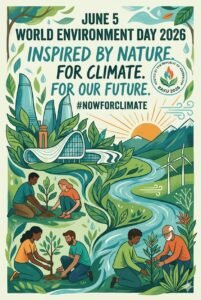
Azerbaijan’s national campaign for World Environment Day 2026 centers around the theme: “Inspired by Nature. For Climate. For Our Future.” It highlights the dual planetary crises of climate change and ecosystem degradation, emphasizing their interconnected impacts on both people and the planet.
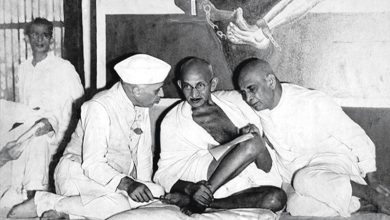
As we observe World Environment Day, Mahatma Gandhi’s holistic worldview becomes profoundly significant in addressing climate change and securing the future of coming generations. Gandhi’s perspective is rooted in the unity and oneness of all creations—both sentient and non-sentient—a philosophy foundational to Indian tradition.
Such an approach views the entire world as a single, interconnected entity where an event in one part of the globe inevitably impacts the rest. It calls for an alternative civilization and lifestyle that transcends narrow geographical borders. Ultimately, only such a civilizational shift can solve a crisis that is, at its core, a product of our modern way of life.
About the Author
Dr.Siby K.Joseph is : Director, Sri Jamnalal Bajaj Memorial Library and Research Centre for Gandhian Studies,
Sevagram Ashram Pratishthan, ,Wardha- 442102, Maharashtra (INDIA) Email: directorjbmlrc@gmail.com