By Dr. Siby K. Joseph
While reviewing prominent historical correspondence in our archives to prepare for an upcoming international delegation, I found myself immersed in a collection of profound historical value. The archive contains Mahatma Gandhi’s letters to Count Leo Tolstoy, Adolf Hitler, and President Franklin D. Roosevelt, alongside Albert Einstein’s famous, signed appreciation of Gandhi.
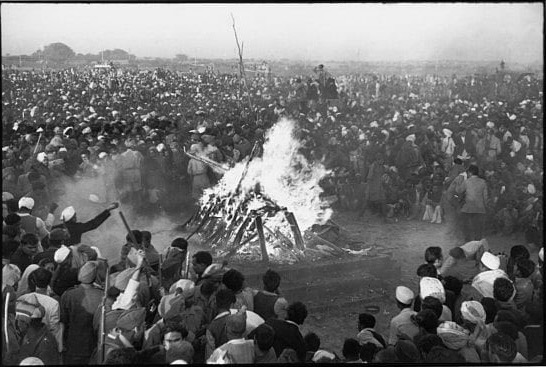
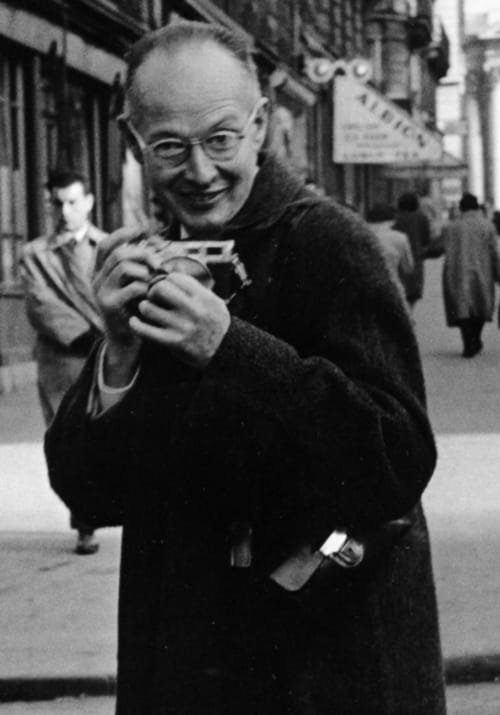
Among these treasures in the archives of the library and research centre of Sevagram Ashram, a specific document caught my attention: a typed contemporary dispatch by the legendary French photographer Henri Cartier-Bresson, who famously captured Gandhi’s final hours and funeral. In the typescript, a striking passage stood out:
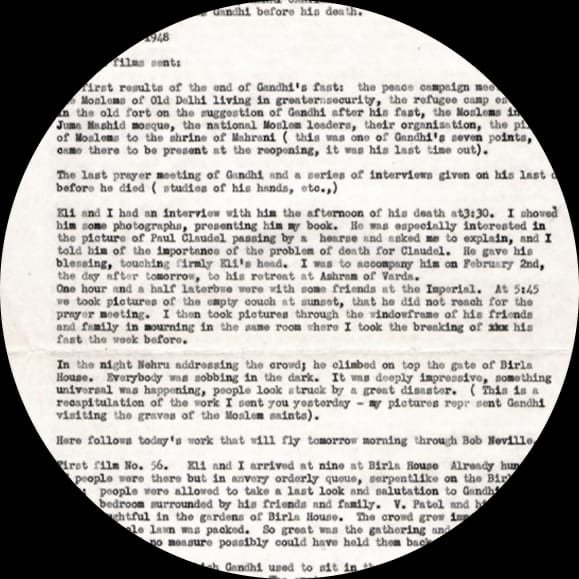
“Eli and I had an interview with him the afternoon of his death at 3:30. I showed him some photographs, presenting him my book. He was especially interested in the picture of Paul Claudel passing by a hearse and asked me to explain, and I told him of the importance of the problem of death for Claudel.”
Though I was already familiar with Cartier-Bresson’s iconic photographs of Gandhi, discovering this specific account sparked my curiosity. On January 30, 2026, coinciding with a visit from an international delegation from Gandhi International, France—who were attending a five-day immersion program on Gandhian thought and practice at the Sevagram Ashram—I delivered a presentation on the Mahatma’s final moments. This presentation was primarily based on Cartier-Bresson’s photographs and global newspaper reports from the time.
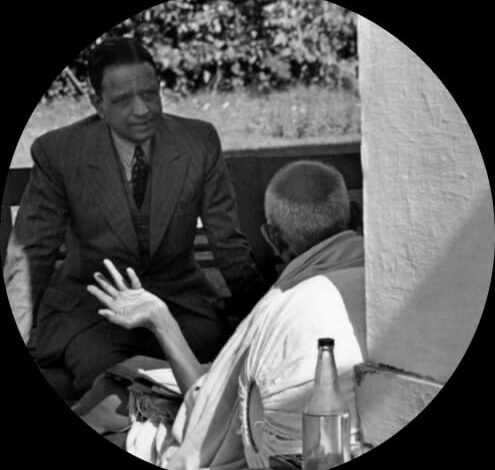
Historical records confirm that Cartier-Bresson was among the last people to converse with Gandhi before his assassination.
During their meeting, the photographer presented Gandhi with a copy of his 1947 exhibition catalogue from New York’s Museum of Modern Art (MoMA). Inscribed in the upper right corner were the author’s words of deep reverence: “To our beloved Bapu, with deepest respect, Henri Cartier-Bresson, New Delhi, 30 January 1948.”
I cross-referenced our archives with MoMA’s records to locate the exact photograph. The image depicts the French poet and diplomat Paul Claudel walking past an elaborate, horse-drawn funeral hearse in the Auvergne-Rhône-Alpes region of southeastern France.
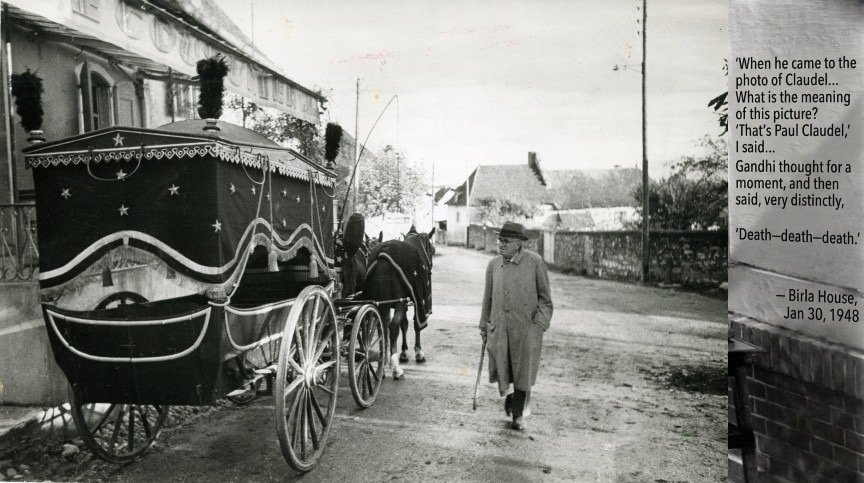
Paul Claudel (1868–1955) was a deeply devout Roman Catholic whose poetry and plays were intensely preoccupied with the themes of spiritual exile, divine grace, and the thin veil separating the physical world from the afterlife. For Claudel, death was never a morbid end, but a profound threshold of spiritual transformation—a “problem” to be navigated with absolute faith.
To dig deeper into this encounter, I located a profile of Cartier-Bresson written by Dan Hofstadter and published in The New Yorker on October 16, 1989. In it, the photographer provided a chilling, firsthand account of that fateful afternoon. According to Hofstadter’s profile, Cartier-Bresson recalled Gandhi slowly reviewing the MoMA catalogue, pausing at the photo of Claudel gazing at the hearse, and asking about its meaning. After Cartier-Bresson explained that the picture depicted a poet deeply concerned with the spiritual issues of life and death, Gandhi thought for a moment and then said, very distinctly, “Death—death—death.”
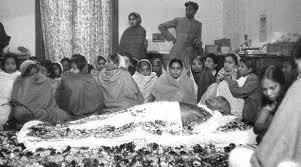
People mourning the tragic death of Mahatma Gandhi . Nathuram Godse fired three bullets from a close range.
The photographer said goodbye to him at 4:45 PM that afternoon, and later, he heard the cries in the streets that Gandhi had been shot. This meeting took place on the afternoon of January 30, 1948—a day when Delhi was suffocating under the weight of post-Partition communal violence, and Gandhi had only recently ended a grueling fast-unto-death to restore peace between Hindus and Muslims. It was just over an hour away from his own fateful walk to the prayer ground at Birla House. The image of the French poet served as a mirror, reflecting the heavy theme of mortality that had quietly hung over Gandhi for several days, leading to his whispered, repetitive response.
Having survived a bomb blast at his prayer meeting just ten days prior on January 20, he knew the threats to his life were mounting, yet he steadfastly refused extra security. He had previously said to Manuben Gandhi:
“If I were to die of disease or even a pimple, you must shout to the world from the housetops that I was a false mahatma. Then my soul, wherever it might be, will rest in peace. People might well swear at you for my sake; yet, if I died of illness, you should declare me a false or hypocritical mahatma. And if an explosion took place, as it did last week, or somebody shot at me and I received his bullet on my bare chest, without a sigh and with Rama’s name on my lips, only then you should say that I was a true mahatma. This will benefit the Indian people.”
Just before the prayer meeting, he was in a meeting with Sardar Patel. When Manu Gandhi informed him about the visitors from Kathiawar who wished to see him, Gandhi replied, “Tell them that, if I remain alive, they can talk to me after the prayer on my walk.” All of this creates a powerful impression of the Mahatma walking forward with unusual calmness, choosing to meet his fate unshielded.
Just as I finished this archival search, two researchers visited our library. As we discussed our collections, I shared this newly uncovered story of Paul Claudel and the hearse. Both researchers were deeply struck by the account, noting that this poignant historical moment is virtually unknown to the general public, and they strongly urged that it be shared for wider dissemination.
After they left, I found myself reflecting deeply on the incident. Was Gandhi somehow foreseeing his imminent demise, or did his thrice-repeated utterance of “death” unwittingly mirror the three bullets that would claim his life just moments later?
Gandhi was not a man who normally repeated words idly for emphasis, leaving one to wonder if the moment was a haunting, subconscious foreshadowing of his end on January 30, 1948. While one might be inclined to dismiss thoughts of divine prophecy, it remains undeniable that many of Gandhi’s final reflections carried a profound, predictive weight.
Ultimately, this fleeting afternoon encounter between a French photographer, the image of a French poet, and an Indian leader reveals a stunning convergence of universal spiritual thought. To the global observers who watched his final hours unfold, Gandhi’s life—and his eerily prophetic chant of “death, death, death”—affirmed that he was far more than a political leader. By facing his unshielded end with absolute faith, much like the spiritual threshold described by Claudel, his final moments became a cosmic reflection of the very transcendent peace he spent his entire life chasing.