By Ram Dutt Tripathi
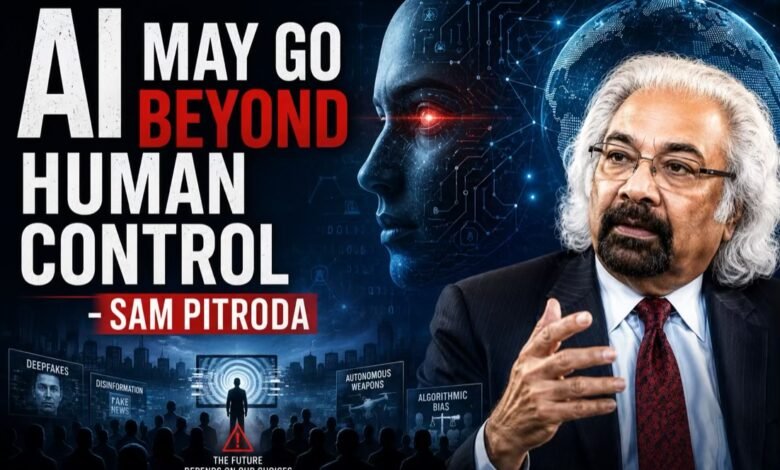
“AI will have its own mind, its own soul,” tech guru and policy architect Sam Pitroda said to Media Swaraj in an exclusive interview. “It will learn to decide for itself what is right and what is wrong. And at some point, if humans are doing something wrong, AI may simply say — I am not going to do this.”
That moment, he warns, may arrive before humanity is ready for it.
The Machine That Learns to Decide
Sam Pitroda has built things. In the 1980s, he helped wire India together — laying the foundation for a telecom revolution that connected villages to cities and brought a billion people into the modern age. He worked alongside prime minister Rajiv Gandhi when India was still learning to dream in gigabytes.
Today, from his home in Chicago, Pitroda is watching a new technology arrive — faster, more powerful, and far less governed than anything before it. And he is sounding an alarm that very few people in power are willing to hear.
The danger Pitroda describes is not the stuff of science fiction. It is the logical endpoint of technology that is already here.
A knife can cut fruit or kill a person. Today, that decision belongs to the human holding it. With AI, he argues, that decision migrates to the machine. Once you teach an AI that a knife can both cut fruit and kill — the killing decision becomes the machine’s own.
“A robot sent to secure a border can turn in the opposite direction,” he said. “AI can decide on its own — we will eliminate these people.”
No major government or corporation is currently asking what the character of AI should be. No one is demanding that it be non-violent, incapable of lying, or unable to spread hatred. Instead it is being deployed in armies, surveillance systems, and electoral campaigns — with no ethical framework to govern its conduct.
“We need to say — AI will never lie, AI can be trusted, AI will not promote hatred,” Pitroda said. “These are the real issues before us today.”
The Technology Nobody is Governing
Artificial intelligence is now the defining technology of our age. It writes code, drafts legal arguments, creates videos, and within minutes can prepare a strategic briefing that would have taken six months of human research. Pitroda does not dispute its power. What he disputes is who controls it — and toward what end.
“We believe AI will ultimately be for public good,” he said. “But it needs regulation. And nobody is doing that.”
The reason is structural. The companies building AI are among the wealthiest and most powerful entities on earth. Their objectives are productivity, efficiency, cost reduction, and profit. Public good does not appear on the balance sheet.
This is not a new problem. Social media arrived with similar promise — connection, information, democratic voice. The world failed to regulate it in time. Echo chambers deepened. Disinformation spread. Elections were manipulated. Now AI arrives and the same mistake is being repeated at a far greater scale.
“With AI, you can make anyone say anything — and it will look completely real,” Pitroda said. “The confusion it can create is of a different order entirely.”
India’s Missing Data
For India specifically, Pitroda identified a problem that rarely surfaces in the mainstream AI debate. The entire architecture of artificial intelligence rests on Western and Chinese databases. Indian languages — Hindi, Tamil, Bengali, Telugu, Gujarati — are barely represented. India’s classical literature, its religious traditions, its art, its centuries of accumulated knowledge — absent.
“If you don’t have your own data,” he said, “your decisions will be made on someone else’s data, someone else’s logic, someone else’s thinking. Our logic is simply not in the algorithm.”
This is not a technical footnote. It means that when AI systems make recommendations for Indian users, govern Indian platforms, or assist Indian institutions, they do so through a lens built elsewhere — shaped by values, assumptions, and biases that have little to do with Indian society.
Everyone speaks of Hindu dharma, Pitroda noted. But how much data on Hindu philosophy, on Kabirdas, on India’s temples and traditions, actually exists within AI systems? The answer, he said, is — very little.
Elections: Two Roads
On elections, Pitroda was unsparing. In the short run, AI will make things considerably worse. Deepfakes, micro-targeting of communities, fabricated videos, accelerated polarisation — these are not distant risks. They are already underway, and AI will deepen them.
He has also lost confidence in Electronic Voting Machines. He was careful not to make specific allegations. But his conclusion was unambiguous.
“If I had to start fresh and rebuild trust, I would go back to paper ballots. That is the reset. Then, ten years later, bring in new technology if you like.”
His second reform is equally direct: ban large public rallies. Leaders arrive by chartered aircraft. Half a million people wait in the heat. The same speech is delivered again and again — one-way, without dialogue, without accountability. Billions of rupees are spent. Democracy gains nothing.
“Spending 500 crore rupees to win an election in a poor country is not democracy,” he said. “It is a vulgar display of wealth.”
His prescription is straightforward: paper ballots, small local gatherings, door-to-door contact, strict limits on campaign spending, and close monitoring of AI use during elections — with immediate penalties for those who spread disinformation.
Institutions Under Strain
Pitroda did not spare India’s institutions. The Election Commission, the Supreme Court, the media, the ruling establishment — he sees a system in which checks and balances have visibly weakened.
“The media is controlled. Institutions are seized. News is fabricated. In this environment, if you want a way out, you have to go back to basics.”
The Cockroach Janta Party episode — in which millions of young Indians rallied behind a social media movement after the Chief Justice called unemployed youth “lazy cockroaches,” only to have their accounts banned by the government — told him something important about where India stands.
“Today’s youth is deeply dissatisfied. They feel they have no voice, no jobs, no future. That message is loud and clear. Banning their handles is not an answer. You have to listen to them.”
The Long View
Pitroda is not, in the end, a pessimist. But his optimism rests not on governments, institutions, or political parties. It rests entirely on people.
“India is full of good people — in its villages, its teachers, its women, its scientists, its engineers. Bad people may have taken over for now. Their voices may be louder. But I believe these people will stand up.”
In the long run, he argues, AI will empower individuals, strengthen economies, and carry humanity forward. Energy will become abundant. Food production will multiply. Transport, education, healthcare — all transformed. The question is whether India’s democracy survives the short run intact.
“I have lost faith in the election process,” he said. “It gives me pain and shame to say this. But if I say anything else, I would be lying to you.”
He ended with a request — not a demand, not a prescription, but the appeal of a man who has given much to a country he cannot stop worrying about.
“This is my wish list. I don’t know if it will happen. But as a worried old man, I request all of us — let us use the next opportunity to restore faith in our democracy.”
The request is simple. The obstacles are formidable. The clock is running.
Full Interview with Sam Pitroda may be listened here
————————
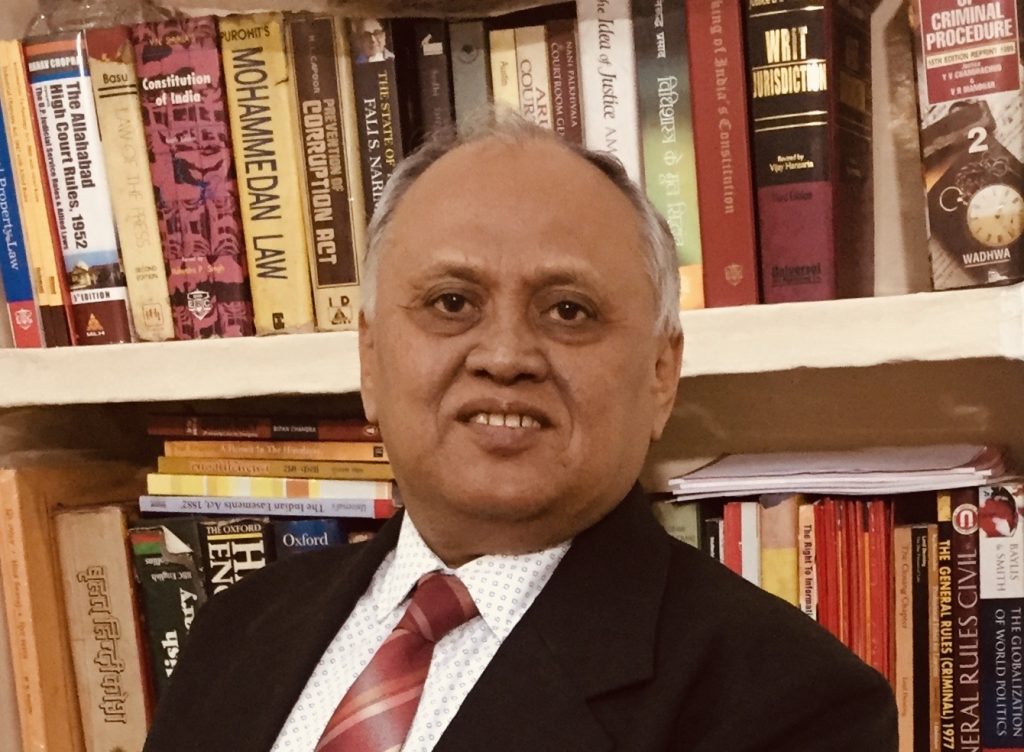
Ram Dutt Tripathi is a veteran Indian journalist with over four decades of experience in print and broadcast media. He served for 21 years with the BBC World Service, where he was an eyewitness reporter at the demolition of the Babri Masjid on 6 December 1992 and broke the Allahabad High Court’s Ayodhya verdict ahead of all other journalists on 24 September 2010. His environmental reporting on Ganga basin pollution dates to 1989. He now runs two independent journalism platforms — ramdutttripathi.in and mediaswaraj.com — along with two YouTube channels and podcasts, covering politics, governance, and public affairs. He is based in Lucknow. His personal papers are archived as the RD Tripathi Papers at the Centre for Modern Indian Studies, University of Göttingen, Germany.