By Siby K Joseph
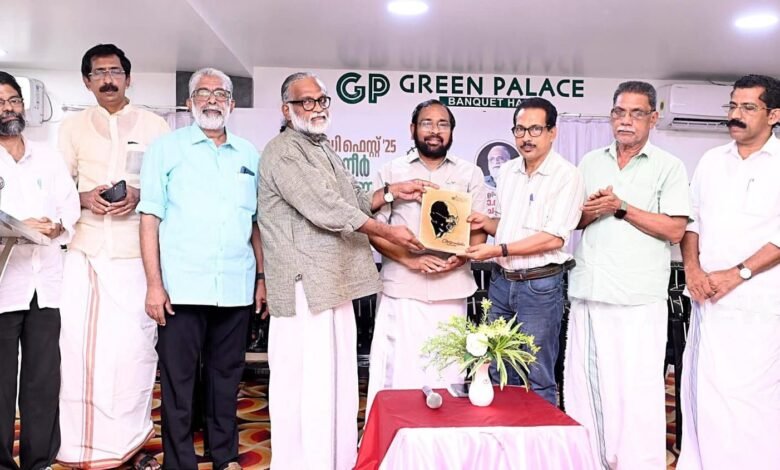
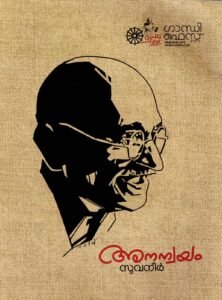
VADAKARA, KERALAM — The official souvenir of the historic Gandhi Fest, titled “Ananwayam” (അനന്വയം), was formally released by Dr. Anil Chelombra in May 2026 at the Green Palace Auditorium in Vadakara, Keralam. Edited by the noted historian and Gandhian scholar P. Harindranath, this prestigious volume compiles a rich treasury of historical archives, contemporary academic scholarship, poetry, and extensive photo documentation of the event. The landmark publication is the definitive product of the monumental three-day Gandhi Fest held in Vadakara from October 3–5, 2025 — a region uniquely blessed by the personal visit of Mahatma Gandhi during the Indian freedom struggle.
A Town That Remembers
Vadakara’s connection to Mahatma Gandhi is not merely commemorative. During the freedom struggle, Gandhi visited this coastal town in North Malabar, leaving an imprint that local memory has carefully preserved across generations. Unlike many Gandhi commemorations elsewhere in India that have become ceremonial and hollow, the Vadakara Gandhi Fest of October 2025 was conceived as a living intellectual engagement — three days of serious scholarship, creative expression, and public dialogue rooted in a place that had actually felt Gandhi’s presence.
This geographical and historical specificity gives Ananwayam its unusual authority. It is not a generic Gandhian anthology produced for a national occasion. It emerges from a community that sees itself as a custodian of something real — a memory, a responsibility, and an unfinished conversation about what Gandhi’s ideas mean in contemporary India, from ecology to the Constitution, from caste justice to economic ethics.
The title of the souvenir, Ananwayam, literally translates to “unparalleled,” “matchless,” or “incomparable.” It represents a deliberate, profoundly symbolic choice by the organizers to signify that Mahatma Gandhi’s life, philosophy, and enduring legacy remain unmatched in human history. In essence, the volume captures a singular, foundational truth: “Gandhi can only be compared to Gandhi himself.” The editorial framework of the compendium opens with an insightful Preface by the editor, P. Harindranath, establishing its academic and philosophical depth. This is accompanied by an introductory essay by Manayat Chandran, Chairman of the Gandhi Fest Organizing Committee, which outlines the structural vision that brought this historic gathering to fruition in North Malabar.
Releasing the volume, Dr. Chelombra underlined the urgency of Gandhi’s philosophy of nonviolence in a contemporary world consumed by violence and war. His remarks gave the occasion a sharp relevance beyond the literary and historical — a reminder that Ananwayam is not an exercise in nostalgia but a call to engagement.
A Volume Built for the Ages
Renowned scholar Dr. Siby K. Joseph, in his critical review titled “The Matchless Mahatma,” hails Ananwayam as a landmark anthology that masterfully bridges the past with the present. The volume serves as an invaluable historical archive, featuring rare, timeless reflections from legendary global leaders and literary icons of yesteryear. Among the classic selections are intimate writings by India’s first Prime Minister, Pandit Jawaharlal Nehru, and an analysis of Gandhi as a “prophet of new modernity” by socialist thinker Dr. Ram Manohar Lohia. Global and artistic perspectives are illuminated through pieces by Nobel Prize-winning American novelist Pearl S. Buck on the Mahatma’s martyrdom, and acclaimed actor Sir Ben Kingsley on the creative process of personifying Gandhi on screen. Regional, literary, and scientific dimensions are further enriched by the legacy writings of eminent scientist K. Bhaskaran Nair, legendary Malayalam renaissance poet Mahakavi Kumaran Asan, revered activist Prof. G. Kumara Pillai, and celebrated ecologist Prof. Madhav Gadgil.
Complementing these archival treasures is an expansive collection of contemporary scholarship from prominent modern thinkers, academics, and writers. This section features deep analytical work, including P. N. Gopikrishnan on the dark tragedy of January 30, 1948; Prof. B. Rajeevan on the multi-layered resurrection of Gandhi; Dr. K. Aravindakshan on Gandhi’s role as a healing doctor; and Prof. K. P. Sankaran on the fundamentals of Gandhian ethics. Environmental intersections are evaluated by Dr. M. P. Mathai, while Prof. Nataraj Huliyar re-examines Gandhi through Lohia’s perspective. Crucial comparative dialogues on social justice, specifically addressing the complex socio-political relationship between Gandhi and Ambedkar, are presented independently by Dr. Sunil P. Ilayidom and Dr. P. M. Girish.
The volume further explores structural and humanistic realms with contributions from Dr. Teresa Joseph on the state and the individual; Dr. Siby K. Joseph on the Quit India Movement and Gandhi’s blueprint for an inclusive India; Dr. M. S. John on a comprehensive approach to human rights; and K. Sahadevan on morality. Specialised institutional and thematic studies round out the modern perspectives, featuring Prof. M. N. Karassery on the unique technological dialogue surrounding Gandhi and the railways, P. Harindranath on Hind Swaraj, S. Gopalakrishnan on the unusual connection between Gandhi and sports, and Adv. E. V. Lijish on Gandhi’s impact on the Indian Constitution.
Beyond its academic prose, Ananwayam elevates its narrative with an evocative selection of tribute poems and creative articles. It concludes with a vibrant, curated photo gallery capturing a thorough visual glimpse of the three-day festival. This seamless blend of rigorous research, literary artistry, and documentary photography ensures that Ananwayam will stand as a holistic, definitive archive for scholars, historians, and followers of Gandhian thought.
Those wishing to obtain a copy of Ananwayam may contact the editor, P. Harindranath, at phareendranath@gmail.com