Siby K. Joseph
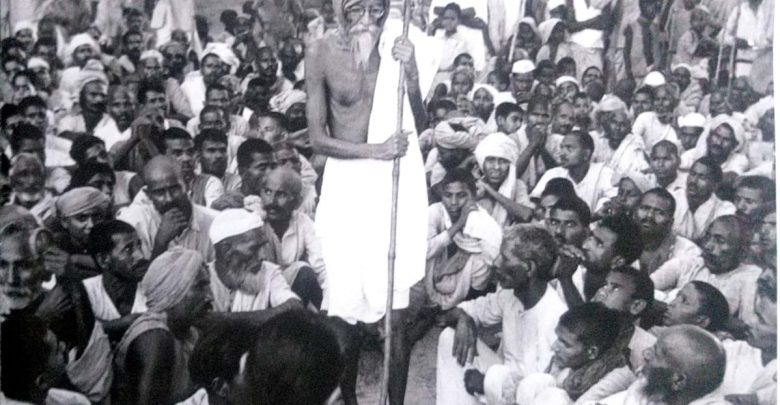
18 April 2026 marks the 75th Anniversary of the Bhoodan Movement, a landmark event in India’s journey towards social justice. What makes this movement particularly interesting is that it was not the result of intense deliberation or a pre-calculated strategy by Acharya Vinoba Bhave, the spiritual heir of Mahatma Gandhi. Instead, it was born out of a spontaneous crisis and a surprising act of individual generosity.
In April 1951, Vinoba Bhave toured Shivarampalli, on the outskirts of Hyderabad, to participate in the third annual conference of the Sarvodaya Samaj from April 8th to 11th.
This trip helped him understand the grim plight of landless people in South India, who were then caught between the mercy of extremist forces and the threat of violence. On the final day of the conference, he announced a padyatra (foot march) through the conflict-ridden Telangana region to spread a message of peace.
During this walk, Vinoba witnessed the fear of villagers who were caught between the police and the Communist insurgents. On April 18th, he entered the Nalgonda district, the heart of the uprising.
His organizers had arranged for him to stay in Pochampally, a large village of about 700 families, two-thirds of whom were landless. Despite the tension in the region, the village gave him a warm welcome.
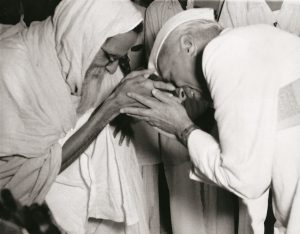
Vinoba took the opportunity to interact with forty Dalit families who were in utter distress due to their lack of land. During the evening prayer meeting, he placed their plight before the community and asked if anyone was willing to donate two acres of land to each of these families for their sustenance.
Noble Gesture of Verde Ramchandra Reddy
Vedre Ramachandra Reddy, a local landlord, stepped forward and pledged 100 acres of his own land to the cause. This selfless act made him the primary catalyst for the Bhoodan Movement.
His noble gesture inspired Vinoba Bhave to launch a nationwide padyatra (foot march) to alleviate the suffering of the country’s landless poor.
As Vinoba traveled from village to village appealing for land donations, the initiative evolved in 1952 into Gramdan—a mission aimed at achieving the Gandhian vision of Gram Swaraj through collective land ownership.
Ultimately, the movement facilitated the collection of approximately 4.7 million acres of land, marking a historic chapter in the global history of non-violent revolution.
The movement’s impact extended far beyond land through a series of allied programmes designed to foster a holistic social transformation along Sarvodaya lines.
These initiatives included Sampattidan (Wealth-gift), which encouraged the donation of financial resources, and Shramdan (Labour-gift), which mobilised voluntary physical work for community infrastructure.
The movement also inspired Jeevandan, where dedicated workers pledged a life-long commitment to the cause, alongside the creation of the Shanti-Sena (Peace-army) to maintain communal harmony through non-violence.
These efforts collectively ensured that the Bhoodan-Gramdan mission addressed the total well-being of the rural poor.”
As we commemorate this Platinum Jubilee, the challenge of landlessness has evolved into complex new forms. In an era marked by rapid industrialisation, globalisation, crony capitalism, and aggressive infrastructure expansion, rural communities are facing a new wave of displacement and economic insecurity. This commemoration, therefore, should be an opportunity to reassess the plight of the poor and landless.
The Inequality Gap
The statistics are stark: the top 10 percent of wealthy families in rural India control 44 percent of the land, while 46 percent of rural families remain entirely landless.
Furthermore, the richest 5 percent of families hold 32 percent of the land, and a mere 1 percent of ultra-wealthy families have 18 percent of rural land concentrated in their hands.
This 75th anniversary serves as a vital reminder of the Gandhian principle of Trusteeship—the idea that wealth and resources should be held in trust for the collective good. There is a pressing need today for a non-violent movement that protects the vulnerable from the shadows of modern growth. By revisiting the lessons of the past, we keep the spirit of Pochampally alive, ensuring a bright future for our nation built on equity and social justice.
About the Author
Dr. Siby K. joseph is Director, Sri Jamnalal Bajaj Memorial Library and Research Centre for Gandhian Studies,
Sevagram Ashram Pratishthan, Sevagram,Wardha- 442102, Maharashtra (INDIA)
Email: directorjbmlrc@gmail.com
Please also see