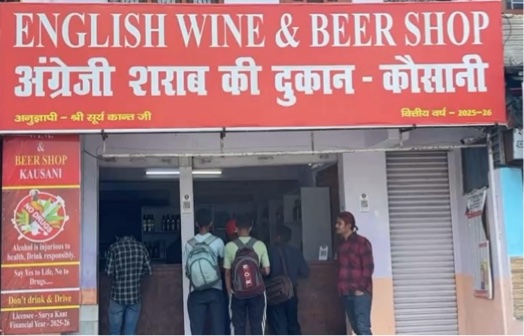
Kausani, Uttarakhand – In an unprecedented move, the Uttarakhand government has opened liquor shops in Kausani — a place forever associated with Mahatma Gandhi, Sarla Behn, and Radha Bhatt, who represent India’s legacy of non-violence, environmental consciousness, and women-led social transformation.
This decision has deeply hurt the sentiments of Gandhian workers and citizens across India. Prominent Gandhian and Padma Shri awardee Radha Bhatt, who has dedicated her life to Sarvodaya and environmental causes, has written directly to Chief Minister Pushkar Singh Dhami, urging him to revoke this move. Despite this, the government has taken no corrective action.
Radha Bhatt, who was recently honored by the Government of India for her lifelong commitment to Gandhian values, has called the opening of liquor outlets in Kausani “an insult to the spiritual legacy of Gandhi and Sarla Behn.”
Sarla Behn, a British-born Gandhian who chose India as her home, founded the Lakshmi Ashram in Kausani and turned the region into a hub for women’s empowerment and ecological activism.
Protests and Demands
Gandhian workers, currently assembled at the historic Anasakti Ashram, where Mahatma Gandhi once stayed and wrote his reflections on the Gita, have raised a strong protest. They have demanded immediate closure of the liquor shops and appealed to the President of India, Smt. Droupadi Murmu, to intervene and uphold the moral sanctity of such heritage sites.
The protesters argue that introducing liquor into these areas not only contradicts Gandhian ideals but also encourages addiction and social decay in a region known for its simplicity, spirituality, and ecological sensitivity.
Gandhian Resolve: Non-Violent Action Begins
In the spirit of Gandhian satyagraha, the protesters have declared that they will continue their movement peacefully. A campaign to picket and resist liquor sales in Kausani will begin, involving senior and youth Gandhian activists. The protest will include silent marches, public awareness campaigns, and moral appeals to the people and the administration.
They assert that their struggle is not against any individual or party but against a culture of consumerism and substance dependence that threatens the social fabric of rural India.
A Call to Protect Sacred Spaces
Kausani is not just a tourist destination; it is a pilgrimage site for those who believe in truth, non-violence, and sustainable living. The decision to open liquor shops here is not merely a policy error—it is a moral violation of India’s freedom movement ethos.
Gandhians have called upon citizens, social organizations, spiritual leaders, and environmental activists to join their peaceful movement to preserve the values of India’s civilizational heritage.
Conclusion:
The liquor trade in sacred Gandhian spaces is a stain on India’s conscience. This movement is a call not just to the Uttarakhand government, but to the soul of the nation: Will we honor the legacy of Gandhi and Sarla Behn—or sell it for short-term revenue?