By Prof Pradeep Mathur
The sudden eruption of revolutionary fervour among the youth has taken both the ruling establishment and the Opposition by surprise. Political analysts, social activists and sections of the intelligentsia who pride themselves on being opinion-makers appear to have no convincing explanation for how this phenomenon has emerged. In the absence of any serious psycho-social study, it is being conveniently attributed to what has become a fashionable term—“Gen Z”.
But Gen Z has always been there. The real question is: why has this anger erupted now?
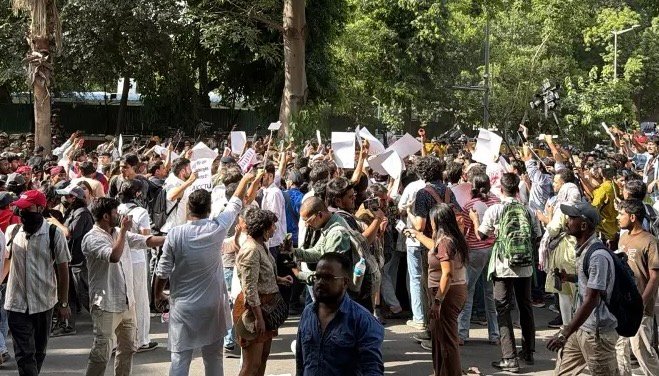
Those observing the Jantar Mantar agitation closely understand that the mere utterance of a word or an isolated incident cannot, by itself, produce a massive nationwide movement of such intensity and endurance. Something deeper is clearly at work. Rising prices, unemployment and irregularities in examinations have undoubtedly contributed to the anger, but none of these problems is new. They have existed for years. Why, then, have they suddenly acquired such explosive force?
There must be something more behind this movement—something that has enabled it to surpass, in reach, intensity and staying power, many of the mass movements witnessed in independent India. Even the 1974–75 movement led by the highly respected Jayaprakash Narayan did not acquire the same character and momentum that the Jantar Mantar agitation has already demonstrated.
————————————–
The Jantar Mantar agitation should not be dismissed as a spontaneous “Gen Z” outburst, but understood as a deeper revival of idealism, social consciousness and egalitarian aspirations.
—————————————-
There is no doubt that the prevailing stagnation and frustration in the system have provoked the agitation. But the stagnation is not merely economic or material. It is also ideological.
I was reminded of this by an incident from my own family. In the early 1990s a cousin of mine, about 25 years younger than me, influenced by the anti-Muslim rhetoric surrounding the Babri Masjid–Ram Janmabhoomi movement started giving vent to his anti- Muslims views. I confronted him and reminded him that our family tradition is of secularism and the clerk of our advocate grandfather was a Muslim whom our entire family respected almost as a family elder. He, in turn, treated us like his own children.
My cousin was visibly hurt and fell silent, but he remained unconvinced.
I began wondering how a young man from a highly educated, secular and enlightened family could acquire such a communal mindset. That led me to examine my own youth. I came from essentially the same family background and grew up at a time when memories of Partition violence were still fresh and stories of communal atrocities were common.
Yet something different shaped me.
Beyond the pursuit of a career, I was fascinated by Marxist ideas of an egalitarian society based on equality, justice and fair play. Socialism became my guiding light. It was undoubtedly a dream, even a utopia, but it was an inspiring dream. It gave young people something larger than themselves to believe in and strive for.
By the time my cousin’s generation came of age, that dream had largely disappeared from public discourse. In its absence, another ideology offered itself as a source of identity and purpose. For him, Hindutva became that guiding light, even though its appeal was accompanied by hostility towards Muslims and an imagined grievance about Muslim rule in India—often without any meaningful understanding of history.
Every young generation needs an ideal, an icon or an idea to pursue.
For a generation coming of age in the 1980s and 1990s, the answer was provided by liberalisation and globalisation. The new dream was no longer socialism but prosperity: a well-paid job, a car, a comfortable home and a higher standard of living. The promise of the market became the new aspiration.
The next generation was shaped by the communications and information-technology revolution. The internet, computers and mobile phones became the defining features of their lives. Mobile technology evolved rapidly—from simple phones to messaging devices and finally to powerful internet-enabled smartphones. Technology became their new god.
Both liberalisation and the information-technology revolution, however, had one major limitation. They were essentially individualistic. They offered enormous opportunities for personal advancement but little incentive to think about society as a whole. They could satisfy material aspirations, provide unprecedented connectivity and transform individual lives, but they had little to say about social responsibility.
As the old saying goes, man does not live by bread alone.
With their material needs better satisfied and the world of the internet literally in their hands, today’s young people appear to be searching for something beyond consumption and personal success. They have inherited from their parents a largely apolitical existence, but they are increasingly conscious of its limitations. They may have more possessions, more information and more opportunities than earlier generations, yet many feel that something essential is missing—a sense of social purpose.
What they are rediscovering is social conscience.
That, I believe, is the deeper significance of Jantar Mantar.
The phenomenon should therefore not be dismissed simply as a temporary Gen Z outburst. Nor should it be reduced to anger over one examination, one government decision or one political controversy. It represents, at least in part, a revival of the instinct for humanism and concern for the weak and disadvantaged—an instinct that had been buried for decades beneath the pressures of money, careerism and individual success.
Interestingly, many of those participating in or supporting this movement do not themselves belong to the economically deprived sections of society. They are not necessarily the victims of poverty or deprivation. Yet their social conscience has brought them into the streets and persuaded them to put their own comfort, careers and security at stake for those who have less.
That is what makes the phenomenon significant.
It would be a serious mistake to assume that the Jantar Mantar movement is merely an emotional wave that will soon exhaust itself. If its underlying impulses are understood correctly, it could represent the emergence of a new form of socialist and egalitarian thinking among the young—perhaps without the old labels, slogans or organisational structures.
Idealism has always been one of the natural attributes of youth in India. When young people find no compelling ideal in the established political discourse, they will inevitably search for one elsewhere.
The conservative professional opinion that habitually looks down upon rebellious youth must therefore take this development seriously. So must the administrative machinery. Instead of treating the eruption of youth energy as a law-and-order problem, the state should explore ways of providing greater opportunities for education, employment, dignity and participation within a genuinely inclusive social framework.
The Jantar Mantar phenomenon may well be a warning that economic growth alone cannot provide a society with direction. Decades of growth driven predominantly by individual advancement and market-oriented aspirations have created opportunities, but they have also left large sections of society feeling excluded and unheard.
What is now emerging could be a demand for something more—a society based not merely on growth, but on equality, justice, dignity and social responsibility.
To dismiss the movement as an Opposition conspiracy, a passing Gen Z fad or merely a law-and-order challenge would therefore be a colossal mistake.
The sooner the Modi government understands the deeper social message behind this eruption of youth anger, the better it will be—not only for the government, but for the country.I have deliberately kept the political thrust of your original intact, but made the argument less repetitive and more persuasive by presenting the movement as a generational search for an ideal rather than simply an economic protest.
( Veteran journalist and media guru, Prof Pradeep Mathur is Chief Editor of Mediamap news network and Chairman of MBKM Foundation, a voluntary Organisation)