Siby K. Joseph

Sevagram Ashram is perhaps the most significant site in our history—a place where one can still feel the pulse of India’s freedom struggle. It was here, during the final and most profound chapter of his life, that Mahatma Gandhi undertook his most radical experiments in human living, spanning the socio-economic and political realms.
His arrival in Wardha was not a mere change of location; it was the result of a specific historical turning point. Sevagram was fundamentally different from his earlier communities, such as the Phoenix Settlement and Tolstoy Farm in South Africa, or the Satyagraha Ashrams in Kochrab and Sabarmati. It was not an “ashram” in the traditional sense; it was a laboratory of non-violence, where principles were tested on the ground to be applied both nationally and internationally. Today, we revisit Sevagram not just as a monument of the past, but as a living philosophy that continues to impact our troubled world.
The Vow and the Journey to Wardha
The historic Salt March of 1930 concluded fifteen years of Ashram experiments at Kochrab and Sabarmati. Gandhi took a solemn vow that he would not return to Sabarmati until India gained independence. This decision reflected the deep sense of non-possession he had developed through years of spiritual sadhana.
After his release from Yerwada Jail, he arrived in Wardha in September 1933, staying at Bajajwadi, the residence of Jamnalal Bajaj. Following a historic tour for the upliftment of the downtrodden, Gandhi returned to Wardha on August 7, 1934, staying at the Satyagraha Ashram managed by Vinoba Bhave.
In a significant paradigm shift, Gandhi resigned from the Congress in 1934 to focus solely on the upliftment of Indian villages and the attainment of the Swaraj of his dreams. By 1935, he was staying at Maganvadi, seeking a typical village—one lacking basic facilities—to begin his experiments. Segaon was identified by his disciple, Mirabehn, and despite the hesitation of his colleagues, Gandhi immersed himself in village life.
The “Mobile Ashram” and the “Madhouse”
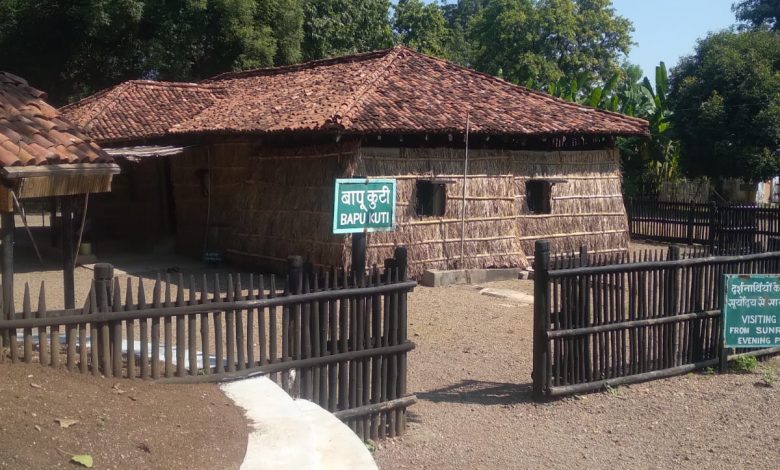
On April 30, 1936, at age 67, Gandhi made Segaon his home. Initially living in a makeshift shanty under a guava tree, his goal was to transform the entire village into an ashram. By June 1938, he noted that the community had become a “mobile Ashram,” carrying its principles everywhere. This included a commitment to manual labor and the insistence that Harijan servants be treated as brothers. As he explained: “We must do even menial work that we can do ourselves… Only work that even others cannot do may we ask Harijans to do.”
When Rajkumari Amrit Kaur questioned the time he spent on the personal affairs of the “mad inmates” of the Ashram, Gandhi famously replied: “I know mine is a madhouse and I am the maddest of the lot. But those who cannot see the good in these mad people are blind.”
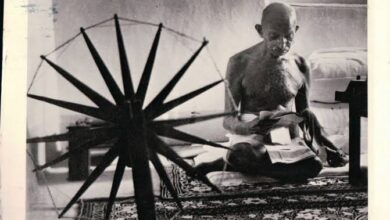
By 1940, he humorously called Segaon a “home for invalids,” including himself. He pushed for radical minimalism and the Takli-yajna (spinning) as an act of silent service. To Gandhi, this “madhouse” was a spiritual laboratory where patience and empathy were the ultimate tools for revolution. Over time, Segaon was renamed Sevagram—the “Village of Service.”
Daily Life and Embodied Service
Daily life was defined by a spiritual tone and rhythmic devotion. The community focused on embodied service: daily chores, sanitation, looking after cows, planting trees, and welcoming guests. For Gandhi, quiet moments spent in reading, writing, and reflection were vital. From this humble setting, he provided guidance to everyone—from local villagers to global leaders.
Major Decisions and Experiments at Sevagram
From this laboratory of non-violence, Gandhi launched several profound initiatives that shaped the future of India:
• Nai Talim (The Wardha Scheme): The journey began with the 1937 All-India National Education Conference at Wardha, which established a “cradle-to-grave” scheme of free, compulsory education in the mother tongue, centered on manual crafts. Sevagram served as the primary testing ground, successfully liberating learning from the four walls of the classroom.
• Decentralized Governance (The Aundh Experiment): In 1938, Gandhi helped draft the Swaraj Constitution for the princely state of Aundh. It marked the first time an Indian monarch voluntarily abdicated his divine right to rule to grant full power to his people.
• Defying Social Stigma: In 1939, Gandhi made the radical decision to admit Parchure Shastri, a Sanskrit scholar suffering from leprosy, into the Ashram. Defying extreme social stigma, Gandhi built a dedicated hut and personally massaged Shastri’s wounds daily, viewing him as a “medium” for his own examination of non-violence.
• Individual Satyagraha (1940–41): In response to Britain involving India in WWII without national consent, Gandhi launched a moral campaign for free speech. From Sevagram, he handpicked participants committed to non-violence, choosing Acharya Vinoba Bhave as the first Satyagrahi.
• Finalizing the Constructive Programme: In 1941, Gandhi codified his ideas into a concrete plan of action for the nation. This document served as the moral and strategic guide for the independence movement.
• The Quit India Movement: In July 1942, Sevagram witnessed a historic meeting where the Congress Working Committee passed the “Quit India” resolution. This moment marked Sevagram as the de facto capital of a nation on the brink of independence.
Conclusion
By revisiting its legacy on this 91st anniversary, we gain a deeper understanding of how Sevagram defined the freedom struggle. By introducing visionary schemes and programs at a critical historical juncture, Gandhi transformed this humble village into the de facto capital of the country. Beyond national independence, Sevagram offered a blueprint for a sustainable, non-violent global order. Ultimately, it reminds us that a small, dedicated community can indeed become the pulse of a global revolution.
Note: This article is adapted from a presentation by Dr. Siby K. Joseph on the occasion of the 90th anniversary of Sevagram Ashram.
Please listen Sam Pitroda about the legacy of Mahatma Gandhi