By Siby K. Joseph

Gandhi’s institutions in Wardha and Sevagram represent one of the most remarkable acts of nation-building in modern Indian history.
Long before independence, Mahatma Gandhi understood that ideals without organisations are merely words. His journey as an institution-builder began in South Africa — with the Natal Indian Congress (1894) and the British Indian Association (1903) — and through communal experiments at Phoenix Settlement and Tolstoy Farm.
This early phase saw the establishment of the International Printing Press in 1903 to publish Indian Opinion, a vital tool for mobilising the community and documenting the Satyagraha struggle. Upon his return to India, Gandhi recognised the power of the press as a public trust; in 1919, he took over Navajivan and Young India, eventually founding the Navajivan Trust in Ahmedabad (1929). By vesting the ownership of his writings and printing activities in a public trust, he ensured that his message of truth and non-violence would remain a non-commercial, permanent resource for the nation.
On Indian soil, he established the Satyagraha Ashram at Kochrab in 1915, later moved to Sabarmati, and founded Gujarat Vidyapith during the Non-Cooperation Movement.
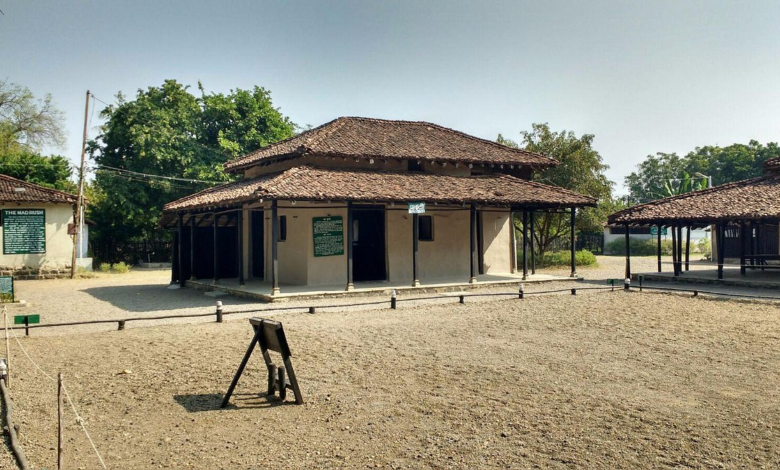
But it was in Wardha and Sevagram that his institutional vision reached its fullest expression. As we mark 91 years of Gandhi’s historic move to this region, the time is right to revisit how he became the catalyst for an enduring ecosystem of organisations that still serve the nation.
Beyond the experiments at Sevagram, the surrounding Wardha region evolved into the administrative headquarters for the nation’s constructive work even before Gandhi’s permanent arrival.
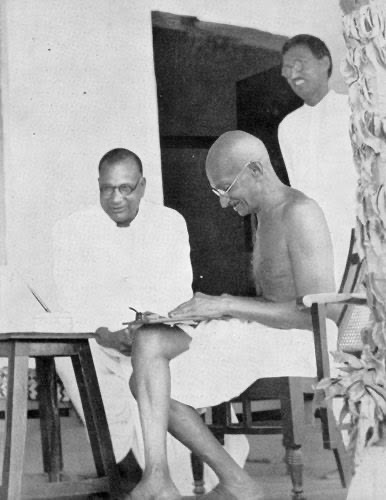
This was made possible through the dedicated efforts of three personalities — Mahatma Gandhi, Jamnalal Bajaj, and Acharya Vinoba Bhave — who secured Sevagram and Wardha’s place in the annals of Indian history.
The Institutional Ecosystem
The framework they built addressed every facet of national life. A vital precursor was the Satyagraha Ashram at Wardha, established in 1921. Founded by Acharya Vinoba Bhave at the request of Jamnalal Bajaj, it functioned as a branch of the Sabarmati Ashram and served as a base for spiritual and constructive work in Central India. Gandhi himself stayed here during his 1934 visit before moving to Sevagram.
In the realm of economic self-reliance, the All-India Spinners’ Association (AISA) (1925) shifted its central office to Sevagram to promote Khadi as a means of national independence.
This was complemented by the All-India Village Industries Association (AIVIA) (1934), headquartered at Maganwadi, Wardha on land donated by Jamnalal Bajaj. In 1938, Gandhi inaugurated the Magan Sangrahalaya here — the first museum of Khadi and Village Industries — to showcase the evolution of the charkha and village crafts.
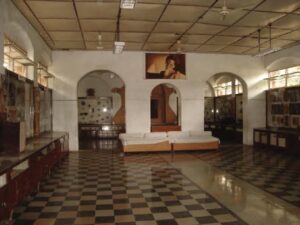
To unify the country through a common linguistic identity, Gandhi founded the Rashtrabhasha Prachar Samiti (1936), supported by leaders such as Dr. Rajendra Prasad and Jawaharlal Nehru.
This was followed by the Hindustani Prachar Sabha (1942) to promote a blend of Hindi and Urdu as a common lingua franca. In 1938, the Hindustani Talimi Sangh was established to implement the Nai Talim (Basic Education) scheme.
Social Welfare and Compassion
Social welfare and compassion were institutionalised through groundbreaking initiatives like the Maharogi Seva Samiti (1936) at Dattapur. Founded by Manohar Diwan, it was India’s first indigenous leprosy care centre.
Healthcare was further expanded in 1945 when Dr. Sushila Nayar transformed a small dispensary in Jamnalal Bajaj’s cottage at Sevagram into the Kasturba Hospital.
That same year, the Kasturba Gandhi National Memorial Trust (1945) was established to focus on the welfare of rural women and children.
A cornerstone of this social transformation was the Harijan Sevak Sangh, founded by Gandhi in 1932 while he was still incarcerated in Yerwada Prison.
Following his release, Wardha became the nerve centre for his 1933 nationwide tour dedicated to the welfare of the ‘untouchables.’ This was not merely a political campaign but a deep-seated institutional experiment.
At Sevagram, Gandhi moved beyond advocacy to direct action; he deliberately challenged orthodox taboos by employing members of the Harijan community in the ashram kitchen and mandating that all residents participate in communal dining and sanitation work.
In doing so, he transformed Sevagram into a living laboratory where the structural dismantling of caste was built into the very rhythm of daily life.
The spiritual and grassroots work was spearheaded largely by Vinoba Bhave, who founded the Gram Seva Mandal (1934). Vinoba eventually settled at Paunar Ashram (1938), which later became home to the Brahma Vidya Mandir, a community of women practising spiritual self-reliance.
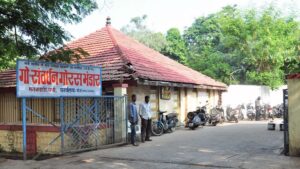
To support the rural economy, the Goras Bhandar (1939) and Go Seva Sangh (1941) were established to address cattle conservation. Supporting this entire structure was the Gandhi Seva Sangh (1923), which provided vital financial assistance to the families of Satyagrahis. Even after Gandhi’s assassination, his institutional vision culminated in the formation of Akhil Bharat Sarva Seva Sangh and Sarvodaya Samaj, during a conference in Wardha in March 1948.
Conclusion
As we mark the 91st anniversary of Gandhi’s historic settlement in Sevagram, the relevance of these institutions remains undiminished. Gandhi the “Institution Builder” reminds us that while individuals may pass, the organisations they leave behind ensure that their ideals remain actionable, accessible, and enduring. Wardha stands today not just as a site of memory, but as a testament to the power of structured, collective action in the service of humanity.
Note: This article is adapted from a presentation by Dr. Siby K. Joseph on the occasion of the completion of 90 years of Sevagram Ashram.