
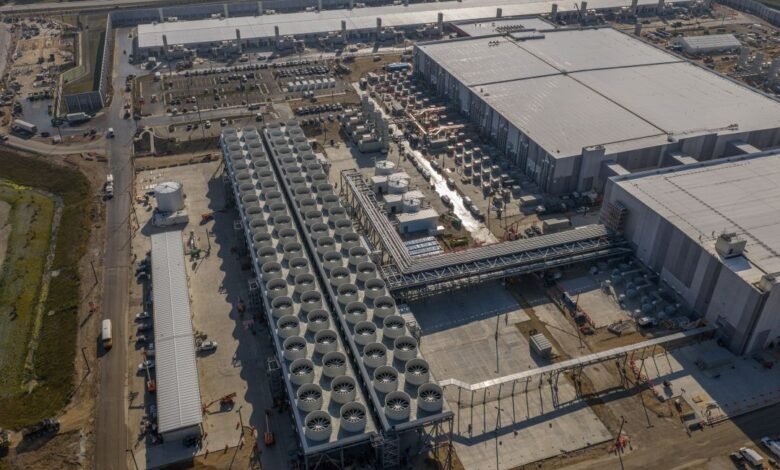
In recent times, reports in The New York Times and The Guardian have highlighted a growing global trend: people in several countries are protesting against data centers. In multiple U.S. states—such as Pennsylvania, Missouri, and North Carolina—local communities have begun opposing data center projects.
In some places, the issue has even entered electoral debates; several projects have been delayed or cancelled, and some states have attempted to impose temporary moratoriums. According to estimates, nearly $156 billion worth of projects were affected in 2025 due to such resistance.
The Guardian described this as a “warning for Big Tech”—people no longer want development at any cost; they are demanding sustainable and equitable development. Projects without local consent are becoming increasingly difficult to implement.
This resistance is not against technology itself, but against a model of development in which resources, power, and decision-making are becoming concentrated in a few corporate hands.
This raises some fundamental questions:
- Is digital development human-centric, or merely technology-centric?
- Is Mahatma Gandhi’s warning—“machines become a threat when they displace human beings”—becoming a reality today?
- Could India also witness a similar conflict between development and environmental/resource pressures?
Data Centers: Invisible yet Powerful Infrastructure
Today, data centers have become the backbone of the modern economy. The internet, cloud services, social media, and AI—all operate through them.
Large data centers consume between consume between 50 and 500 megawatts of electricity, while AI-focused facilities are reaching levels up to 1 gigawatt.
AI fundamentally learns from data, and training it is an extremely energy-intensive process. To learn from data, AI uses a special kind of mathematical framework called a neural network. A neural network is essentially a system of computer programs and mathematical equations that identifies patterns in data.
Running and training these systems requires powerful hardware such as CPUs, GPUs, and specialized AI chips.These chips perform repeated calculations on millions and even billions of examples—such as text, images, and audio—so that the system can recognize patterns. During this process, high-performance GPUs operate continuously, leading to significant electricity consumption.
There is also another hidden cost: cooling. These machines generate a large amount of heat, and keeping them cool requires additional energy and water. In many cases, a substantial portion of total energy consumption goes solely into cooling.
As a result, data centers are not just technological infrastructure; they exert significant pressure on energy, water, and land resources—and this is where local resistance often begins.
India: A Convergence of Opportunity and Challenge
India is rapidly emerging as a major data center hub, with cities like Mumbai, Chennai, Hyderabad, and Noida at the forefront. However, India’s realities are complex:
- A vast population
- Limited resources
- Power shortages in several regions
- High water requirements for cooling (even as cities like Bangalore face water stress)
- Dependence on coal-based energy, leading to higher carbon emissions
- Deep socio-economic inequalities
In such a context, if data centers expand rapidly without careful planning, India could face the same situation seen in parts of the West—a growing conflict between development and the pressures on resources and the environment.
Indian AI: The Question of Data, Language, and Culture
India’s greatest strength is its diversity. If India is to build its own AI, it will need:
- Data in local languages
- Cultural context
- Literature, folk knowledge, art, and music
However, merely collecting data is not sufficient. It also requires:
- High-quality, well-curated data
- Control over bias
- Data annotation
- Adequate computing power
This is not just a technical issue, but a cultural one. If we fail to preserve our languages and knowledge traditions in digital form, AI will inevitably reflect and amplify a Western perspective—leaving control in the hands of global corporate entities.
Employment: A New Phase of Transformation
Several economists, including The Economist, have pointed out that while the Industrial Revolution primarily disrupted blue-collar jobs, AI is now beginning to reshape white-collar work as well. Tasks such as data entry, accounting, customer support, translation, and basic content creation are rapidly being automated or transformed through AI systems.
Analyses by Carl Benedikt Frey and Daron Acemoglu suggest that many jobs may not disappear entirely, but their nature will change significantly. The central concern, therefore, is not simply unemployment, but the widening skill gap between those who can adapt to AI-driven systems and those who cannot.
For a country like India, this transition could have particularly serious consequences. India has a vast young population, but a large section of the workforce is employed in routine, low-skill, or semi-skilled service-sector jobs.
Many of these roles—especially repetitive office-based tasks—are vulnerable to automation. At the same time, the education and skilling systems in many parts of the country are still not adequately prepared for an AI-driven economy.
This creates the possibility of a new kind of inequality: a divide between a small, highly skilled digital workforce and a much larger population struggling to remain economically relevant. Without large-scale investments in education, digital literacy, and reskilling, AI could deepen existing social and economic disparities rather than reduce them.
There is also a deeper social concern. Some thinkers have even warned of a future in which governments may be able to provide basic welfare—food, healthcare, or subsidies—but not meaningful employment. Such a society may achieve technological efficiency, yet still face a crisis of dignity, participation, and purpose. Employment is not merely a source of income; for millions, it is also a source of social identity and self-worth.
At the same time, AI may also create new opportunities in areas such as data annotation, local-language AI services, digital infrastructure management, and human-AI collaboration. The real challenge for India, therefore, is not whether AI will arrive, but whether society and institutions can prepare people to participate meaningfully in this transformation rather than being excluded from it.
Decentralization: India’s Path Forward
Mahatma Gandhi’s idea of “Gram Swaraj” can today be reimagined as “AI Swaraj.”
In a country as diverse as India, the centralisation of AI is neither effective nor just. If data and AI development remain confined to a few major cities or global corporations, they will fail to capture the country’s linguistic and cultural diversity. In contrast, if:
- Data collection takes place at the state and district levels
- AI is developed in local languages
- Local youth are provided with training
then a more inclusive and representative AI can be built.
Such an approach would also generate local employment—through activities like data annotation, transcription, and digital services. If combined with structured skilling initiatives, this would not remain a source of temporary jobs alone, but could lay the foundation for a new digital economy in which villages and small towns become active participants in the AI development process.
Environment and Decentralisation: A Balanced Path
In the context of AI and data centers, environmental concerns have now moved to the forefront. Large, centralized data centers not only consume enormous amounts of electricity but also place significant pressure on water resources. In several countries, it has been observed that data centers draw heavily on local groundwater, potentially intensifying water scarcity in surrounding areas. In a country like India, where many cities are already facing water stress, this becomes a serious concern.
Moreover, if the energy used to run these data centers is primarily coal-based, it can further aggravate carbon emissions and the broader challenge of climate change.
It is here that decentralisation offers an important solution. If data centers are developed in smaller, distributed forms, the burden on resources does not remain concentrated in a single location. Smaller facilities across different regions can be linked to local energy sources—such as solar, wind, or hydro—thereby not only decentralising energy use but also reducing carbon emissions.
Decentralisation also enables solutions tailored to local conditions. For instance, in water-scarce regions, low-water cooling technologies can be adopted, while in naturally cooler climates, energy requirements for cooling can be significantly reduced.
Another important dimension of decentralisation is community participation. When development takes place at the local level, people are no longer passive observers but active stakeholders. This enhances transparency, reduces resistance, and makes development more equitable.
Thus, decentralisation is not merely a technical or economic strategy; it can evolve into a model of environmental and social balance—one that makes development more sustainable, just, and resilient in the long run.
The Final Question: The Direction of Development
AI is not merely a technology—it represents a profound restructuring of society, economy, and even human relationships. And ultimately, it brings us back to the same question raised by Mahatma Gandhi:
Please also listen Ram Dutt Tripathi conversation with tech Guru Sam Pitroda
Will development empower human beings, or gradually make them dependent, passive, and replaceable?
The real challenge of AI is not only about machines becoming more intelligent; it is about whether human beings will continue to remain central to the idea of progress. A society may become technologically advanced, economically efficient, and digitally connected—yet still grow more unequal, alienated, and environmentally fragile.
If questions of dignity, employment, community, and ecological balance are ignored, technological progress alone cannot be called true development. The danger is not simply that machines may become powerful, but that human beings may lose control over the direction in which society itself is moving.
If we fail to ask these questions today, technology may continue to advance rapidly—while large sections of humanity are left behind. If we confront these questions honestly, AI may yet become not a force that replaces humanity, but one that strengthens it.

V.K. Pant holds an M.Sc. in Physics and is a retired officer of the Indian Radio Regulatory Service (IRRS), Department of Telecommunications, Government of India. Along with a strong background in science, he has deep interest in literature, history, and Gandhian philosophy. He writes on Indian society, civilizational history, and the promotion of scientific temper.