The Ganga–Yamuna River Basin, one of the most densely populated regions in the world, is facing a deepening environmental and public health crisis. Industrial pollution, contaminated groundwater, toxic agricultural soils and severe air pollution are creating a chain of exposure that threatens ecosystems and millions of people across northern India.
By Ram Dutt Tripathi

The air we breathe, the water we drink and the soil that sustains our food are increasingly under stress across northern India’s most densely inhabited river landscape. Stretching between the Ganga and the Yamuna rivers, the fertile Doab region has for centuries been regarded as the agricultural heartland of India.
Today, however, this historic landscape is undergoing a disturbing ecological transformation.
Evidence emerging from pollution control authorities, environmental studies and field observations suggests that the Ganga–Yamuna River Basin is facing a layered environmental crisis where air pollution, groundwater contamination and toxic residues in agricultural soils interact to create long-term risks for both ecosystems and human health.
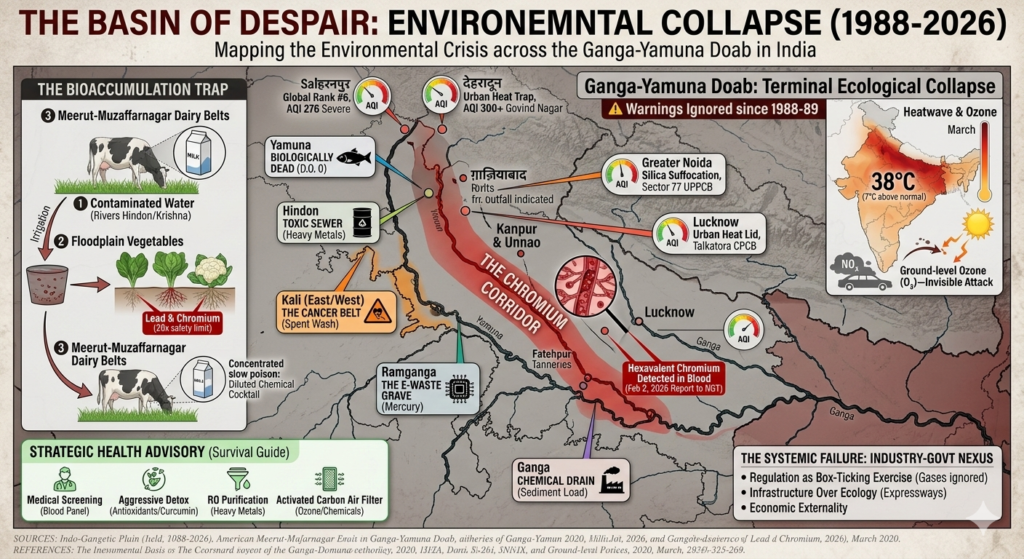
For millions of residents, particularly the poor who depend directly on local water sources and agricultural produce, exposure to environmental pollution has become part of everyday life.
A Three-Front Ecological Assault: Air, Water and Soil
Environmental degradation in the basin is no longer limited to isolated pollution incidents. Instead, it has evolved into a systemic crisis affecting air quality, water resources and agricultural soil simultaneously.
Ground-Level Ozone and Urban Air Pollution
Across cities in northern India, especially the rapidly expanding urban belt stretching from Delhi to western Uttar Pradesh, rising temperatures and intense sunlight accelerate chemical reactions between vehicular emissions and industrial nitrogen oxides.
The result is the formation of ground-level ozone, a harmful pollutant that damages lung tissue and aggravates respiratory diseases. According to the World Health Organization, prolonged exposure to ozone and fine particulate pollution significantly increases the risk of asthma, chronic obstructive pulmonary disease and premature mortality.
For outdoor workers such as construction labourers, street vendors and traffic personnel, exposure to polluted air can extend for ten to twelve hours each day.
Groundwater Contamination
Industrial clusters across the Ganga–Yamuna River Basin have long struggled with inadequate waste treatment and weak environmental enforcement.
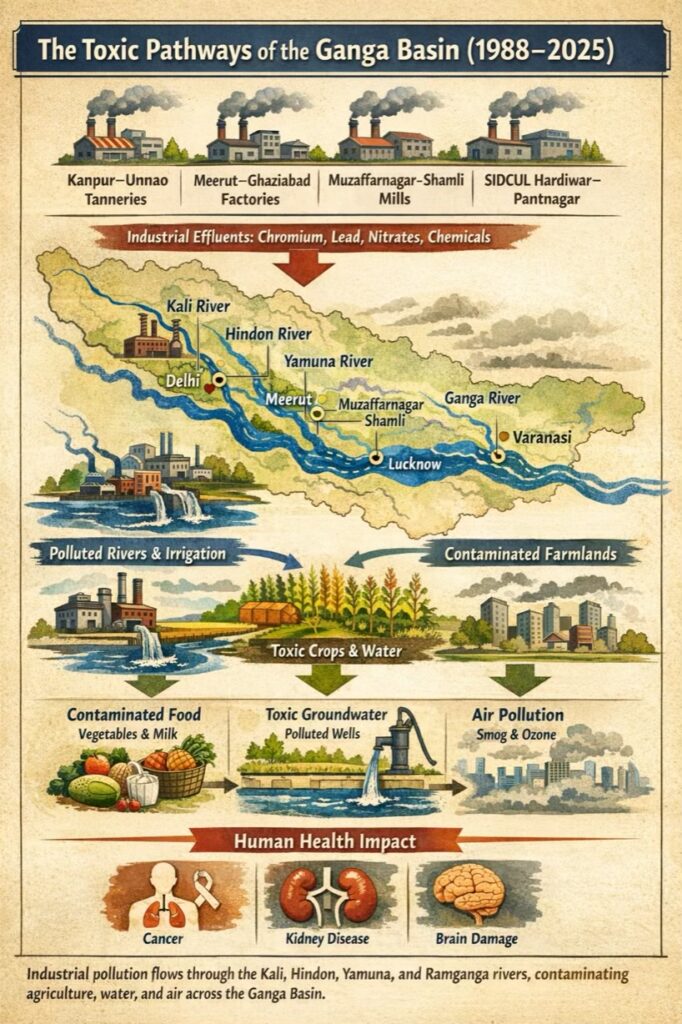
Effluents from leather tanneries, electroplating units, chemical factories and small-scale industrial units have seeped into groundwater aquifers that supply drinking water to nearby communities.
Investigations presented before India’s environmental regulatory bodies and studies conducted by pollution control authorities have documented the presence of hexavalent chromium and other toxic metals in groundwater near industrial belts such as Kanpur and Unnao.
Recent reports detecting chromium traces in human blood samples from residents living near tannery zones in Kanpur have further heightened concerns about long-term exposure.
Toxic Food Chains
Pollution does not remain confined to rivers and drains.
Industrial discharge and contaminated irrigation water can introduce heavy metals into agricultural soil. Over time, these contaminants accumulate in vegetables and crops grown in floodplains near polluted rivers.
Studies on environmental contamination have repeatedly shown how heavy metals such as lead, chromium and cadmium can enter the food chain through soil and irrigation water.
This creates a slow but persistent pathway of exposure affecting millions of people who depend on locally grown produce.
The Rise of Basin-Linked Diseases
Environmental stress across the Ganga–Yamuna River Basin is increasingly reflected in patterns of public health.
Medical practitioners in several districts of western Uttar Pradesh have reported growing numbers of patients suffering from respiratory illnesses, skin disorders and gastrointestinal diseases in communities living near polluted drains and industrial discharge points.
Respiratory Illness
Air pollution across the Delhi–NCR region and adjoining districts continues to contribute to rising cases of asthma and chronic obstructive pulmonary disease (COPD), even among non-smokers.
Cancer Concerns
In districts such as Muzaffarnagar and Shamli, where rivers like the Kali receive untreated industrial effluents, local doctors have observed increasing instances of gastrointestinal and skin-related cancers.
Neurological Risks for Children
Environmental studies have shown that lead contamination in soil and water can impair neurological development in children, reducing cognitive ability and affecting long-term learning capacity.
Kidney Disorders
In agricultural areas where nitrate contamination is common, rural populations have reported higher incidences of kidney-related illnesses linked to unsafe groundwater.
Environmental Injustice: Pollution and the Poor
Environmental degradation in the basin follows a familiar global pattern: pollution disproportionately affects those with the least protection.
Daily wage labourers, small farmers and informal workers often spend long hours outdoors where pollution exposure is highest.
Many rural households depend on shallow borewells or hand pumps drawing from aquifers that may already be contaminated by industrial discharge or agricultural chemicals.
By contrast, affluent households increasingly rely on air purifiers, bottled water and advanced filtration systems. This widening gap in environmental protection highlights how ecological decline often translates into social inequality.
The Economic Cost of Ecological Decline
Environmental illness also carries heavy economic consequences.
Chronic respiratory disease, kidney disorders and other pollution-linked health problems reduce productivity and increase healthcare expenditure for working families.
Loss of workdays, rising medical bills and declining physical health can push already vulnerable households deeper into cycles of debt.
In the long run, environmental degradation may also affect the reputation and market value of agricultural produce from the region, potentially threatening rural livelihoods across the Ganga–Yamuna River Basin.
Regional Hotspots of Concern
Several areas within the basin have emerged as environmental hotspots where industrial growth, urban expansion and weak pollution controls intersect.
| Region | Key Environmental Concern | Social Impact |
| Delhi–NCR | Severe air pollution and microplastics | Rising respiratory illness |
| Muzaffarnagar–Shamli | Industrial discharge into Kali river | Contaminated groundwater |
| Kanpur–Unnao | Chromium contamination from tanneries | Health risks for nearby settlements |
| Dehradun–Saharanpur | Construction dust and urban expansion | Respiratory stress |
| Lucknow | Vehicular nitrogen oxide pollution | Long-term urban health risks |
Public Health Precautions
While systemic environmental reform is essential, basic precautions may help reduce exposure in high-risk areas.
• Periodic medical check-ups including heavy-metal screening in industrial regions
• Improved water filtration systems capable of removing toxic metals
• Greater awareness about environmental health risks among local communities
However, individual precautions alone cannot address a crisis driven by structural environmental failures.
A Warning Ignored for Four Decades
The ecological stress now visible across the Ganga–Yamuna River Basin did not emerge suddenly.
As early as 1988–89, investigative reports published in the Hindi daily Amrit Prabhat documented industrial pollution entering rivers of the Ganga basin. Subsequent reporting for BBC Hindi and later investigations published on Media Swaraj continued to highlight the same pattern: expanding industrial activity, weak enforcement of environmental regulations and mounting ecological damage.
Despite the Environment (Protection) Act of 1986 and multiple government initiatives aimed at cleaning the Ganga, pollution from industrial clusters, urban expansion and chemical-intensive agriculture has continued to intensify.
Today the consequences are visible not only in polluted rivers and degraded soils but increasingly in human bloodstreams.
Please also read :
The basin that once nourished one of the world’s oldest civilizations now faces a stark question: whether ecological balance can be restored before environmental decline becomes irreversible.
( With input from AI tools )