
Ram Dutt Tripathi
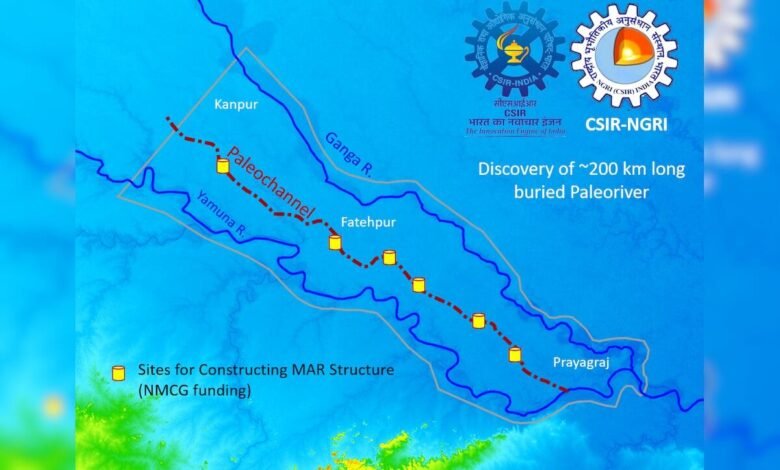
In a groundbreaking scientific revelation near the Ganga-Yamuna Sangam in Prayagraj, researchers from CSIR-NGRI have confirmed the existence of a massive, ancient underground river channel. Spanning over 200 kilometers from Prayagraj through Fatehpur to Kanpur, this “ghost river” or paleo-channel was mapped 15 meters below the surface using advanced airborne geophysical technology. This discovery has ignited a significant debate among geologists and historians regarding the path of the legendary Saraswati River and offers a revolutionary solution for groundwater management and water security in Uttar Pradesh.
According to Hyderabad based geoscientist Dr. Subhash Chandra, from CSIR – NGRI this is not an ordinary groundwater stream but a gigantic “paleo-channel” — the buried course of an ancient river that once flowed on the surface nearly 10,000 to 12,000 years ago before disappearing underground.
Credit goes to once a fire brand Hindutv leader Ms Uma Bharti , who sanctioned the survey project as the union minister for water resources. Uma Bharti has deep commitment for the cleaning of the Ganga river and resigned as minister in frustration as not much could be done to restore the river health. Having deep faith in Hindu religious texts and traditions Ms Uma Bharti was interested in discover of the ancient and mythical Saraswati river . However scientists had more interest in ground water recharge.
Now findings of this project are being used to launch ground water recharge projects in the area by Namami Gange project.
A 4–5 Kilometer Wide Ancient River
Scientific surveys suggest that this paleo-channel is approximately 4 to 5 kilometers wide, comparable in scale to the present-day Ganga and Yamuna rivers. The channel lies around 10 to 25 meters below the ground surface.
Drilling and geological investigations revealed extensive sandy deposits beneath the surface. Scientists say such sand formations are typical “river channel deposits,” considered a clear signature of ancient river flow.
Researchers also observed meandering patterns in the buried sand layers, similar to the winding flow structures of the Ganga. These patterns are regarded as strong “river signatures” in geological studies.
The Technology Behind the Discovery: An “X-Ray of the Earth”
The discovery was made using advanced Heli-borne Electromagnetic Technology. In this method, a large electromagnetic sensor loop, around 30 meters in size, is suspended below a helicopter flying roughly 30 meters above the ground.
According to Dr. Chandra, the technology functions like an “X-ray of the earth,” enabling scientists to create a three-dimensional model of underground layers, including water-bearing zones, rocks, clay, and sandy formations.
In densely populated regions where helicopter surveys were not possible, researchers used ground-based technologies such as Electrical Resistivity Tomography (ERT) and Ground TEM.
Physical Drilling Confirmed the Evidence
Scientists did not rely solely on electromagnetic data. They conducted physical drilling at several locations where sensors indicated the possibility of an ancient river channel.
Excavations at these sites revealed sandy soil deposits consistent with ancient riverbeds, strengthening the evidence that a large river once flowed through the region.
Key survey and drilling locations included Sarai Akil, Sirathu, Manjhanpur, Fatehpur, and Balwant Tola.
Is This the Lost Saraswati River?
The discovery has naturally revived speculation about the legendary Saraswati River mentioned in the Rigveda.
However, Dr. Subhash Chandra remains cautious. He says it would be scientifically premature to declare this buried channel as the Saraswati without completing detailed mapping all the way to the Himalayas.
For more information please also listen this interview :
Further research is needed to determine the river’s original source and whether it was connected to paleo-channels previously identified in Haryana and Rajasthan.
Despite this scientific caution, the cultural and religious significance of a “third river” at the Sangam has intensified public interest in the discovery.
How Did the River Disappear Underground?
Researchers believe major tectonic and geological events thousands of years ago altered the course of this river system.
According to Dr. Chandra, the Ganga, Yamuna, and this third river all display similar meandering patterns, suggesting they may once have belonged to the same fluvial and tectonic system.
A major geological disturbance may have forced this river beneath the surface while the Ganga and Yamuna continued flowing above ground.
A Potential Solution to India’s Water Crisis
Scientists believe this discovery is not merely of archaeological or cultural importance — it could also offer a long-term solution to groundwater depletion and water scarcity across North India.
Massive Potential for Groundwater Recharge
The paleo-channel could function as a gigantic underground reservoir. By directing rainwater into these sandy channels through scientifically designed recharge structures, groundwater levels could potentially be restored on a large scale.
Under the Namami Gange Programme initiative, six demonstration recharge sites have reportedly been approved. These structures aim to channel rainwater directly into the sandy aquifers located 10–25 meters underground.
Relief from Arsenic and Fluoride Contamination
Researchers also believe the project could help reduce arsenic and fluoride contamination in groundwater.
When groundwater levels fall, minerals such as arsenopyrite present in the earth can release arsenic into water supplies. Maintaining stable groundwater levels through recharge may reduce this process.
Fresh rainwater entering the aquifer could also dilute contaminated groundwater and create pressure that pushes polluted water away from cleaner zones — a process scientists describe as the “Push Back Effect.”
Can the River Flow Again on the Surface?
According to Dr. Subhash Chandra, it is unlikely that this ancient river will naturally re-emerge as a flowing surface river because its original Himalayan feeder system is no longer actively connected.
However, if future mapping successfully traces the paleo-channel back to its Himalayan origin, it could dramatically improve scientific understanding of northern India’s river systems and groundwater dynamics.
A Discovery Important for Civilization, Science, and the Future
The paleo-channel identified between Prayagraj and Kanpur may represent far more than a buried geological structure. It could become a major chapter in understanding the hydrological history of the Indian subcontinent.
If future research validates these findings, the discovery could reshape our understanding of ancient river civilizations while also offering a sustainable framework to address groundwater depletion, river pollution, and water scarcity across the Ganga plains.
Please watch full interview with Dr Subhash Chandra
———————–

Ram Dutt Tripathi is an independent journalist based in Lucknow with 21 years at BBC Hindi. An eyewitness to the Babri Masjid demolition and the journalist who broke the Ayodhya verdict in 2010, he has spent four decades covering politics, governance, and environmental issues — particularly Ganga pollution. He now publishes independently at ramdutttripathi.in and mediaswaraj.com.