Prof Hemant Kumar Shah
In the scorching heat of May, the sudden rise of the new Cockroach Janata Party in India and the joining of millions of people in it has increased the political heat. Whether this new political phenomenon is truly about throwing a challenge to the current ruling or opposition political parties by forming a political party, or whether it will just remain an online sensation, only the coming days will tell.
But the Modi government is scared of it because it has got its social media account shut down in the name of the country’s security. However, this phenomenon also has a connection with a major literary phenomenon of the world.
Cockroach in German Literature
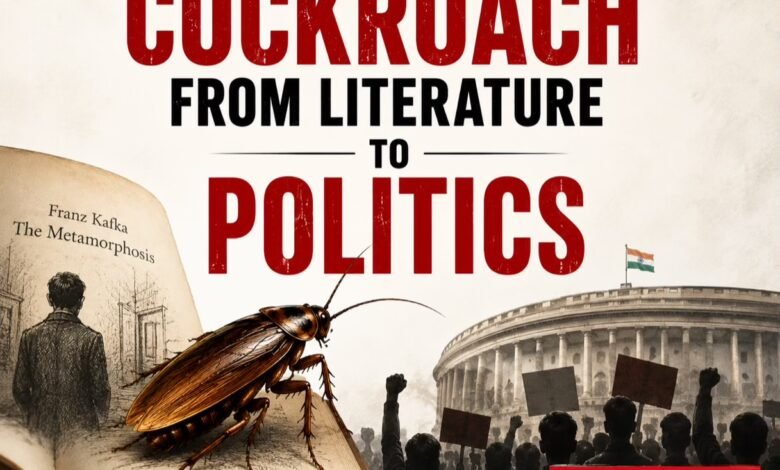
A novella titled ‘Metamorphosis’ was written in 1915 by the famous German writer Franz Kafka (1883-1924). In it, a salesman turns into a cockroach-like insect! This novella is considered one of the greatest novellas in the world, and Franz Kafka, even though he did not receive the Nobel Prize, is regarded as one of the most widely read and discussed writers in the world.
In this novella, there is a salesman named Gregor Samsa who wakes up from sleep in his house one morning and suddenly realizes that he is transformed into a large, cockroach-like insect! This cockroach tries to adjust to his home, and his family members also try to adjust to him.
Initially, he thinks that this transformation of his is not permanent but temporary. He also becomes unemployed! He cannot go to his company’s office. When people from his company come to his house, they cannot understand whatever he says, and his family members cannot understand anything either.
In his house, he keeps crawling here and there as a cockroach, unable to do anything else. He becomes a burden on the household because he is unemployed.
He himself is also afraid of whether he will forget that he was once a human being. The family members feel a heavy burden in taking care of him, and in the end, he commits suicide in his room by willingly starving himself.
Indian Cockroach Janta Party
Now let us compare the character of this short 75-page novella with the unemployed youth whom the Chief Justice of India, Suryakant Mishra, called cockroaches.
They are millions in number, and when they woke up on the morning of May 17th, they suddenly learned through the newspapers that they were deemed cockroaches by the Chief Justice of India. But unlike Gregor Samsa, they are not ready to die by committing suicide; instead, they want change in the country. Therefore, this ‘Cockroach Janata Party’ has proposed its main five points, which are important for political and economic change in India. In this party, created by a single cockroach, young people who look like humans have joined as cockroaches! The cockroach—which evokes disgust, and to kill which pesticide or a tool like a broom is always used—has now become a popular symbol of change.
Youth Attraction towards CJP
Why have the youth of the country joined this so-called new party? The reason for this is their frustration that has arisen during Narendra Modi’s rule over the last 12 years. The brazen violation of constitutional values of freedom, equality and justice is ingrained in the young minds. In the five-point core program stated by the party, there is nowhere a demand for asking anything for free, but there is talk of an effort to clean up the political and economic system. For instance, the issue of 50 percent reservation for women is related to the disappointment arising from the fraud that was committed in the recently hurriedly called specially convened session of Parliament just before the assembly elections of five states.
It is also a fact that if some BJP leader or some government minister had called the unemployed youth cockroaches, perhaps so much resentment would not have spread. But it was said by the Chief Justice of the country, therefore it became a sensation and became highly hurtful to the feelings of crores of youth.
Look at the dreadful situation of unemployment: at present, the unemployment rate in the country is around 5.6 percent, which is much higher than that of any developed country. The proportion of unemployment among the youth in the age group of 15 to 29 is as high as 16 percent. They have become victims of the economic situation created by the policies of political dispensation. That is why, in this situation, they want to create some completely new scenario that is more bearable for them and in which there is a more liberal democratic system.
How fascinating it is that just as cockroaches living in gutters or drains come out as night falls, here the unemployed youth, openly transforming into cockroaches themselves, have come out day and night without the inspiration of any incarnation (avatar), religious narrator or motivational speaker.
Franz Kafka had highlighted the problem of modern technical and insensitive society and the alienation of the individual by turning man into a cockroach; Abhijit Dipke has knowingly or unknowingly called upon millions of unemployed youths to come out as cockroaches and perform their constitutional duty by getting ready for change after cleaning the political and economic gutters.
It seems, after 110 years, Franz Kafka has been reborn in India—not as a literary figure or character but as a political transformer.
Please listen this conversation on Cockroach Janta Party . Ex BBC journalist Ram Dutt Tripathi talking to Prof Hemant Kumar Shah
Author : Prof. Hemantkumar Shah is former Principal of HK Arts College, Ahmedabad.Prof Shah is a Political and Economic analyst.