Some journeys are not about the destination. They are about the tea cooling in your thermos, the hills appearing suddenly around a bend, the unexpected 90-kilometre stretch where the road opens up and you feel, just for a while, completely free. Dr. Viranchi Acharya — microbiologist, wanderer, and resident of Junagadh — set out before dawn from Abu Road with his family, choosing the quieter roads through Pali, Ajmer and Jaipur over the crowded highways. What followed was two days of driving, discovering, and feeling — from the dusty warmth of Haryana to the cool pine air of Dharampur, a hill town resting quietly in Himachal Pradesh between Chandigarh and Shimla. This is his diary. Part one of a journey still unfolding.

— Dr. Viranchi Acharya, Microbiologist, Junagadh
Day 1: Abu Road to Charkhi Dadri
The journey began in that sacred silence which exists only before dawn. We left Abu Road at 5:15 AM — hearts full of excitement, the open road ahead.
Instead of the usual crowded highways, we chose the calmer route through Pali, Ajmer, and Jaipur. It was the right call. The early morning air was fresh, the light spread softly across the land in shades of gold, and the smooth roads made driving feel less like effort and more like meditation.
Bhavna had filled the thermos with tea and green tea the night before. Throughout the day, those warm sips felt like small blessings. Our homemade theplas and snacks turned simple roadside pauses into moments of genuine comfort — unhurried, unplanned, and quietly perfect.
“To travel is to discover that happiness often hides in ordinary moments.”
The surrounding hills rose and fell beside us — sometimes distant, sometimes near — as if reminding us that nature is generous to those who rise early and keep moving.
As the sun climbed, the character of the land revealed itself. The roads were disciplined. Drivers used their horns sparingly. There was a calm rhythm in the movement around us that made long-distance driving deeply satisfying. Civilisation, sometimes, is heard in silence.
The highlight of the day came without warning — a 90-kilometre express highway stretch where cruising close to 100 km/h felt smooth and quietly liberating. On most national highways, the limit is 80 km/h with vigilant speed sensors watching. Here, for a blessed stretch, the road simply opened up.
By 6:30 PM, after scenery, discipline, tea, laughter, and motion, we rolled into Charkhi Dadri — a town carrying the earthy warmth of Haryana culture and the energy of its busy marketplaces. Reaching there felt like the satisfying close of a story told one kilometre at a time.
Day 2: Charkhi Dadri to Dharampur — Plains into Mountains
From Charkhi Dadri, we headed toward Dharampur — nearly 450 kilometres away. But the road does not feel long when it keeps changing.
The dusty plains slowly gave way to greener, cooler terrain. The sky filled with silver and grey clouds. The breeze carried the first whispers of mountain air. It felt as if the Himalayas were reaching out from a distance, pulling us gently forward. Music played in the car. The mood was light.

Midway, we stopped at a Punjabi dhaba — hot rotis, rich dal, fresh sabzi, and that particular hunger which only highway driving produces. It was not just a meal. It was part of the journey.
By evening we reached Dharampur — a quiet, elegant hill town in Himachal Pradesh, nestled on the Chandigarh-Shimla National Highway (NH-5) at an altitude of around 1,150 metres. Sitting roughly 35 kilometres from Solan and 60 kilometres from Shimla, it is the kind of place most travellers pass through without stopping — which is precisely why those who do stop remember it.
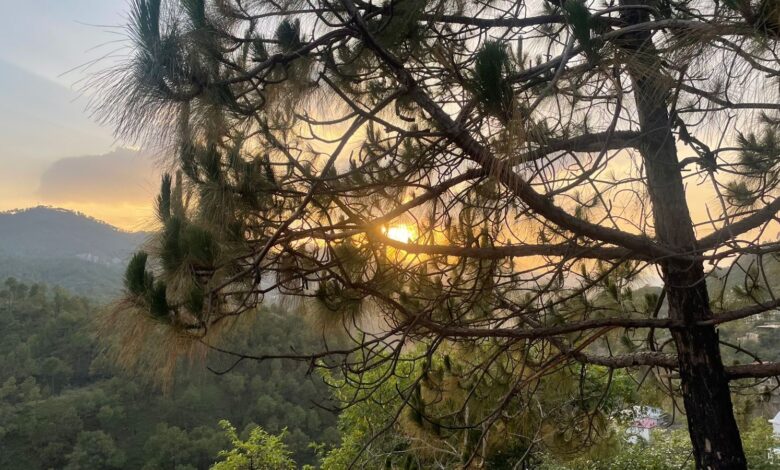
Dharampur does not advertise itself. It does not need to. Once a health retreat during the British era, it still carries an old-world grace — colonial charm, pine forests, clean air, gentle slopes, and a stillness that settles over you before you realise it has happened.
We stayed at Sharma Homestay, outside the town. No hotel lobby, no marble floors — just silence, greenery, and the kind of welcome that only a home can offer.
In the evening we climbed a nearby hill. With every step, the world below looked smaller and the sky above looked grander. Clouds drifted through the valleys. Birds called from trees we could not see. The cool wind felt like a blessing that had been waiting for us.
“The journey, not the arrival, matters.”
Dharampur did not try to impress us. It simply touched the soul. Some places become famous. Some places become unforgettable. Dharampur, for us, belongs to the second kind.
[To be continued — Part Two coming soon]
About the Author
Dr. Viranchi Acharya is a microbiologist based in Junagadh, Gujarat. He brings the same spirit of careful observation to travel that he brings to his laboratory — noticing what others miss, finding meaning in detail.