Siby Kollappallil Joseph

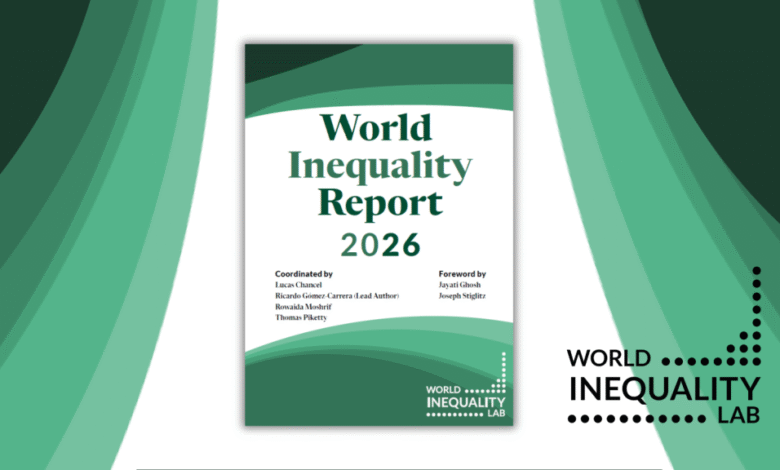
The World Inequality Report 2026, released by the World Inequality Lab in December 2025, offers a powerful indictment of today’s economic system by linking the climate crisis directly to wealth and capital ownership. Based on the work of more than 200 scholars worldwide, the report argues that climate change is not merely an environmental issue but a deeply structural problem rooted in inequality, investment patterns, and the concentration of capital. An analysis by Siby K Joseph .
The World Inequality Report 2026 (WIR 2026) was officially released by the World Inequality Lab in the second week of December 2025. The report, the third edition in the series, draws on the work of over 200 scholars globally to depict that the world is extremely unequal. The first report in this series was published in 2018, and the second in 2022. It was in the 2022 report that a chapter titled “Global carbon inequality” was included to highlight the extreme disparities in carbon emissions between the rich and poor globally and within countries.
Climate Change as a Capital Problem
The World Inequality Report 2026 brought into limelight the analysis of new horizons of climate change that were hitherto lacking in earlier discourses. Chapter 6 of the report, titled “Climate, a Capital Problem,” analyzes that emissions are linked to capital ownership, which is primarily concentrated at the highest wealth levels, indicating that climate change is intrinsically linked to wealth inequality.
What is significant in this analysis is that it brings new facets to the climate crisis by linking it with the existing governance of capital, ownership, investment, and wealth distribution. It advocates for systemic changes to combat climate change and is based on the viewpoint that technical solutions for reducing emissions should go hand in hand with a parallel transformation in the underlying economic system that drives growth and distributes resources.
What the Rich Emit, What the Poor Endure
The foreword, written by Jayati Ghosh and Joseph E. Stiglitz, highlights the key findings of the report in connection with climate change. “According to Chapter 6, the richest 10% of individuals account for 77% of the carbon emissions associated with private capital and 47% of consumption-related emissions, while the poorest half contribute just 3% (and 10% of consumption-based emissions). Climate change also hits the poor hardest: measured relative to their income, the bottom 50% bear about 75% of global climate-driven income losses. These figures make clear that inequality lies at the heart of today’s social and environmental crises.”
The report, based on authentic studies, explains the carbon footprint of capital. It shows that consumption-based emissions are heavily concentrated among the highest income groups, particularly in wealthy nations like the United States. The top 10% income group in the United States has a carbon footprint more than 40 times larger than the top 10% in Nigeria, and over 500 times larger than Nigeria’s bottom 10%.
A person in the global top 1% income group emits approximately 75 times more carbon per year than someone in the bottom 50%. This underscores that global climate change is a problem largely driven by the consumption patterns of the affluent, while its impacts disproportionately affect those in poorer regions who have contributed the least to the crisis.
A key argument is that the traditional “consumption-based” approach to greenhouse gas (GHG) accounting is incomplete because it overlooks the significant impact of capital ownership. “In the United States, the top 10% accounts for 24% of consumption-based emissions but 72% of ownership-based emissions. The share of the top 1% rises from 6% (consumption-based) to nearly 43% (ownership-based).
At the global scale, the contrast is even sharper. The top 1% accounts for 41% of all greenhouse gas emissions under ownership-based accounting, compared with 15% under the consumption approach. Conversely, the contribution of the bottom 50% drops from 10% to 3%.” The report proposes climate regulations and taxation that consider asset ownership, arguing that such an approach would be more progressive than a consumption-based levy. It also highlights a significant issue in global climate policy: the potential contradiction between domestic decarbonization pledges and continued investment in fossil-fuel extraction abroad.
Based on these findings, the report points to a central conclusion: the climate crisis is a capital crisis.It suggests specific policy interventions that are necessary to address the nexus of climate and wealth inequality. “Effective climate action demands that we rethink investment regulations, ownership structures, and the taxation of capital.
Policies such as restrictions on new fossil-fuel investments, progressive wealth taxes imposing an effective carbon penalty, and the expansion of public ownership of climate assets can accelerate the transition and help to reduce wealth inequalities.” It argues that effective climate action must tackle the distribution of capital and ownership patterns. If these aspects are ignored, the result will be a missed opportunity to address the climate crisis equitably, potentially leading to increased inequality.
#WorldInequalityReport, #ClimateAndInequality, #CapitalAndClimate, #CarbonInequality,#ClimateJustice, #WealthConcentration, #SystemicChange, #MediaSwaraj
Dr. Siby Kollappallil Joseph is the director of International Fellowship Program on Nonviolence and Peace and also heads Sri Jamnalal Bajaj Memorial Library and Research Centre for Gandhian Studies,Sevagram Ashram Pratishthan, Sevagram,Wardha- 442102, Maharashtra (INDIA)
Email: directorjbmlrc@gmail.com