By Siby K Joseph
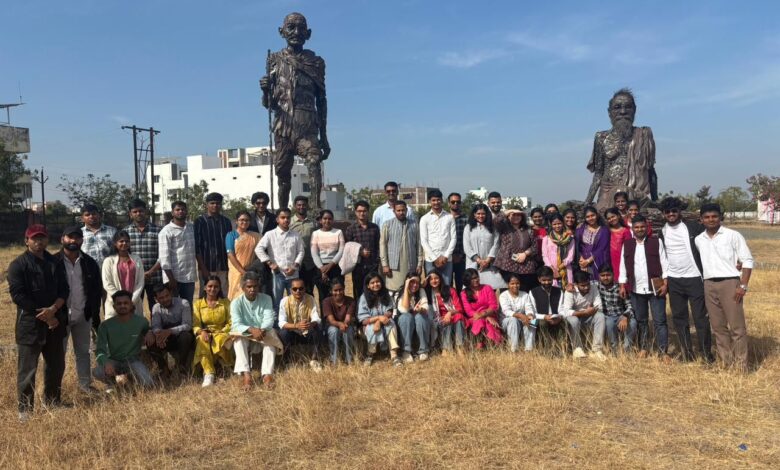
A five-day residential short-term course on Gandhian Thought was held at Mahatma Gandhi’s Sevagram Ashram, Wardha, Maharashtra, from December 23 to 27, 2025, bringing together university and college students from across India.
Organised by the Sevagram Ashram Pratishthan through the Sri Jamnalal Bajaj Memorial Library and Research Centre for Gandhian Studies, the winter camp offered an immersive engagement with Mahatma Gandhi’s life, philosophy, and contemporary relevance in the very space where Gandhi lived and worked for a decade.
Historic Setting for Experiential Learning
The Sevagram Ashram served as Mahatma Gandhi’s residence from April 30, 1936, until his departure on a peace mission in August 1946, during the final phase of his life. The short-term course was designed to familiarise students with Gandhi’s ideas and methods of action through experiential learning, blending academic reflection with community living rooted in Gandhian values.
The programme was open to students from undergraduate to postdoctoral levels, as well as faculty members. More than fifty participants, representing central, state, and private universities, attended the camp. They came from Kerala, Tamil Nadu, Puducherry, Karnataka, Maharashtra, Madhya Pradesh, Uttar Pradesh, Bihar, Delhi, Odisha, Gujarat, and Rajasthan, reflecting the national character of the initiative.
Inaugural Session and Keynote Address
The winter camp was formally inaugurated on December 23 at the Seminar Hall of the Sri Jamnalal Bajaj Memorial Library and Research Centre for Gandhian Studies. The inaugural session began with an introduction by Dr. Siby K. Joseph, Gandhian scholar and Director of the Research Centre.
The keynote address was delivered by Dr. Ulhas Jajoo, eminent medical practitioner, former Professor and Head of the Department of Medicine at the Mahatma Gandhi Institute of Medical Sciences (MGIMS), Sevagram, and co-founder of the Medical Friend Circle.
Pulitzer Prize winner Joseph Lelyveld once remarked, “Gandhi lives in Dr. Jajoo…”, a description that resonates with Dr. Jajoo’s lifelong commitment to Gandhian ideals and rural upliftment.
In his address, Dr. Jajoo explored the contemporary relevance of Gandhi’s experiments, focusing on the theme of “transcending boundaries.” He offered a nuanced distinction between buddhi (intellectual labour) and shram (physical labour), a central element of Gandhi’s Sarvodaya philosophy. By emphasising the dignity of labour, Gandhi sought to challenge social hierarchies and promote economic self-reliance. Dr. Jajoo encouraged students to integrate physical service with intellectual pursuits, drawing from his own upbringing in a Gandhian family.
The session was presided over by Shri Vijay Tambe, who summarised the key learnings. This was followed by discussions on the Charkha economy and the philosophy of Khadi. Concluding remarks were delivered by Shri Barun Mitra, activist, thinker, founder-director of the Liberty Institute, New Delhi, and recipient of the Julian L. Simon Award for his contributions to environmental policy debates.
Introducing Gandhi’s Life and Legacy
To provide a comprehensive understanding of Gandhi’s life, the biographical film Mahatma: Life of Gandhi was screened on the first day of the camp. Participants also undertook a guided tour of Sevagram Ashram, which highlighted its role in India’s freedom struggle and allowed students to experience the simplicity and tranquillity of Gandhi’s living space.
The day concluded with participation in the interreligious evening prayer, a tradition maintained since Gandhi’s time. Conducted in the open ground without electricity and incorporating prayers from multiple faiths, the experience fostered a deep sense of spiritual unity. A discussion followed on the impact of the film and prayer on participants’ understanding of Gandhi’s legacy.
Themes and Academic Sessions
Over the five days, participants engaged with a wide range of themes, including:
- Truth and nonviolence in Gandhian thought
- Misconceptions about Gandhi
- Gandhi’s approach to religion
- Swaraj and the transition from colonialism to nationalism
- Environmentalism: Think Globally, Act Locally
- Gandhi and science
- Biodiversity and sustainable farming
- Globalisation, Artificial Intelligence, and entrepreneurship
- Modern relationships, conflict resolution, and development paradigms
- Sustainability and the legacy of Sevagram Ashram
These sessions demonstrated how Gandhian principles can address contemporary global challenges, helping students contextualise Gandhi in modern times.
The distinguished faculty included Prof. Ulhas Jajoo, Shri Barun Mitra, Shri Vijay Tambe, Dr. Ravindra RP, Shri Sajal Kulkarni, Prof. John Chelladurai, Shri Atul Upadhyaya, Mrs. Prajakta Upadhyaya, Prof. Jeevan Kumar, Dr. Manjushri Landge, Dr. Siby K. Joseph, and others.
Field Visits to Gandhian Sites in Wardha
On December 24, participants undertook field visits to historic Gandhian sites in and around Wardha. The tour included:
- Charkha Griha, featuring statues of Mahatma Gandhi and Acharya Vinoba Bhave and the world’s largest charkha
- Gita Mandir, the samadhi of Jamnalal Bajaj, with 700 Gita shlokas engraved on stone slabs
- Vishwa Shanti Stupa, commemorating Gandhi’s meeting with Fujii Guruji
- Maganwadi, including the All-India Village Industries Association and Goras Bhandar
- Magan Sangrahalaya, showcasing rural technology and village industries
- Paramdham Ashram, Paunar, associated with Acharya Vinoba Bhave
Participants also visited the banks of the Dham River, where the ashes of Mahatma Gandhi and Vinoba Bhave were immersed.
Community Living, Shramdaan, and Cultural Exchange
Each day began with morning prayers, yoga, and meditation, followed by shramdaan activities such as sanitation, gardening, composting, and campus cleaning. Students embraced physical labour with enthusiasm, fostering unity, humility, and mutual respect.
Evenings were devoted to group discussions on themes such as greed versus need, economic equality, gender justice, and reservation policies. Participants also engaged in peace games and a peace walk, reflecting on the interconnectedness of the five elements, nature, and humanity.
On Christmas Eve, the camp celebrated with a cake-cutting ceremony and a cultural programme, where students showcased performances reflecting India’s linguistic and cultural diversity.
Valedictory Session and Reflections
The camp concluded on December 27, 2025, with a valedictory session where participants shared reflections on their transformative experiences. Many students spoke about rethinking their lifestyles and developing a deeper commitment to Gandhian ethics.
The session was attended by Prof. Jeevan Kumar, Prof. John Chelladurai, Dr. Manjushri Landge, Shri Vijay Tambe, and Dr. Siby K. Joseph, among others. The programme was efficiently coordinated by Hari Sonune (MGM University) and Dr. Prince Singh (MGAHV, Wardha). Participants received certificates of appreciation.
Students departed Sevagram Ashram with a renewed sense of purpose, mutual bonding, and a nuanced understanding of how truth and nonviolence can help reconcile modern contradictions.