Media Swaraj Kausani (Uttarakhand) | March 9, 2026
The Himalayas woke up to a heavy silence today. At 4:00 AM, in the quiet sanctum of Lakshmi Ashram, Kausani, a flame that had illuminated the hills for over five decades gently flickered out. David Gerard Hopkins, affectionately known as ‘David Bhai’ across the Gandhian and environmental circles of India, passed away at the age of 78.
A geographer by training and a saint by practice, David Bhai was the bridge between Western scientific inquiry and the profound simplicity of Indian ‘Sarvodaya’.
From London to the Khyber Pass: A Soul’s Journey
Born on December 9, 1947, in London, David was a brilliant student of Geography at Bristol and Leeds Universities. However, his spirit sought a truth beyond academic maps. In 1970, he embarked on an extraordinary overland journey, crossing Turkey and Afghanistan via the historic Khyber Pass to reach India.
Drawn by the ideals of Mahatma Gandhi and the pioneering work of Catherine Mary Heilaman (Sarla Behn), he first arrived in Kausani in 1972. By 1981, he had made the Himalayas his permanent home, eventually renouncing his British past to become a proud citizen of India.
A Partnership of Service: David Bhai and Hansi Behn
David’s integration into the Himalayan soil was completed through his marriage to Hansi Behn, a dedicated worker at Lakshmi Ashram. Their union was a rare example of shared devotion; together, they lived a life of extreme austerity, serving the local communities and the environment. For Hansi Behn, his passing is an irreparable personal loss, and for the Ashram, the loss of its most steadfast guardian.
The “Eyes and Ears” of the Gandhian Movement
The legendary activist Radha Bhatt often remarked that David was her “eyes, ears, and nose” in the administration of the Ashram. Her trust in him was absolute. Senior Gandhian from Uttarkashi, Suresh Bhai, paid his tribute stating:
David Bhai spent his entire life advancing the work of Truth and Non-violence envisioned by Bapu and Sarla Behn. He was a monumental inspiration for the conservation of the Himalayas.”
The Geographer’s Legacy
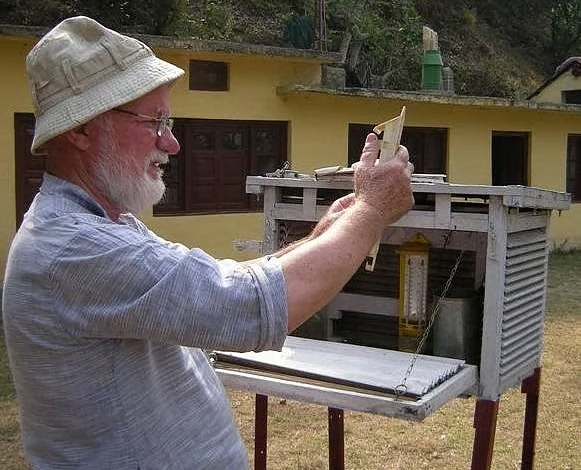
David Bhai was perhaps the most meticulous chronicler of the Himalayan climate.
The Living Archive: He maintained a rigorous daily record of rainfall, snowfall, and temperature for decades, creating a vital database for understanding climate change in the Kumaon region.
Global Voice: By translating Sarla Behn’s biography into English, he ensured that the indigenous environmental movements of Uttarakhand gained international recognition.
The Pillar of Khadi: He was instrumental in managing the Ashram’s Khadi outlets, viewing the spinning wheel not just as a tool of cloth-making, but as a symbol of rural self-reliance.
An Unspoken Heritage
David Bhai leaves behind a treasure trove of memoirs and rare photographs from his 1970s travels—a collection many consider a “World Heritage” in its own right. He lived like a ‘Pahadi’ (hill-man), spoke the local tongue, and understood the rhythm of the springs and forests better than most.
In his passing, the mountains have lost their most humble student and their most dedicated sentinel.
✍️ Key Highlights
- Birth & Education: Born December 9, 1947, in London; studied Geography at Bristol and Leeds Universities.
- Journey to India: Traveled overland in 1970 via Turkey and Afghanistan through the Khyber Pass; arrived in Kausani in 1972.
- Permanent Settlement: By 1981, renounced his British citizenship and became an Indian citizen, dedicating his life to the Himalayas.
- Marriage & Service: Married Hansi Behn, a fellow Gandhian worker at Lakshmi Ashram. Together they lived austerely, serving local communities.
- Role in Gandhian Movement: Trusted by Radha Bhatt, who called him the “eyes, ears, and nose” of the Ashram.
- Environmental Legacy:
- Maintained daily records of rainfall, snowfall, and temperature for decades, creating a vital climate-change database for Kumaon.
- Translated Sarla Behn’s biography into English, giving Uttarakhand’s environmental movements global recognition.
- Managed Khadi outlets, promoting rural self-reliance.
- Cultural Integration: Spoke local dialects, lived like a Pahadi, and preserved rare memoirs and photographs from his 1970s travels.
🌿 Legacy & Impact
- Environmental Conservation: His meticulous climate records are invaluable for researchers studying Himalayan ecology.
- Civic Journalism & Gandhian Ideals: Embodied Sarvodaya (welfare of all), blending Western scientific rigor with Gandhian simplicity.
- Community Service: His life at Lakshmi Ashram exemplified Gandhian austerity and grassroots empowerment.
- Archival Contribution: Left behind memoirs and photographs considered a “World Heritage” for documenting Himalayan life and Gandhian activism.
📌 Why His Work Matters Today
- Climate Change: His long-term data sets provide rare continuity for understanding Himalayan climate shifts.
- Grassroots Empowerment: His Khadi and Ashram work remain models for sustainable rural development.
• • Cross-Cultural Bridge: As a British-born Gandhian, he symbolized the universality of Gandhi’s message.
Please also read :