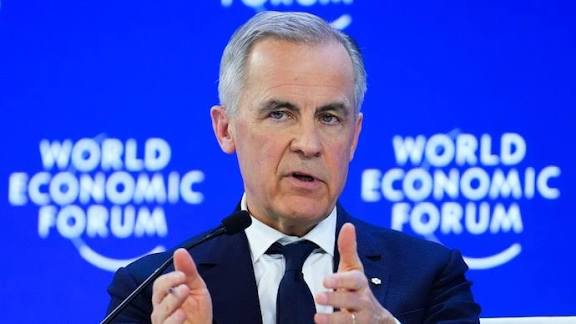
At the 2026 World Economic Forum in Davos, Canadian Prime Minister Mark Carney delivered a speech that has been widely described by leading international media as one of the most consequential addresses of the summit — delivered before the U.S. President’s speech and widely analysed by outlets including The Guardian and Reuters.
Carney’s address cut through diplomatic comfort and polite ambiguity with a stark message: the system long described as a “rules-based international order” is no longer functioning as advertised, and countries that continue operating as if it does are exposing themselves to strategic risks.
This was not an emotional pep talk — it was a sober assessment grounded in decades of experience inside the global power system.
⸻
Who Is Mark Carney — and Why His Role Matters
Mark Carney is one of the most influential figures in global financial and geopolitical affairs. Long known as an economic policymaker, he has served as:
• Governor of the Bank of Canada
• Governor of the Bank of England (the first non-British citizen in that role)
• UN Special Envoy on Climate Action and Finance
In 2025, Carney became Prime Minister of Canada, a shift that transformed his role from technical economic leadership to active geopolitical engagement. That adds significant weight to his warnings at this year’s Davos about the pressures facing the international system.
Leading media outlets have taken note:
• The Guardian highlighted that his speech emerged as a realist critique of nostalgia for the old rules-based order and warned that middle powers must adapt, not retreat.
• Outlets such as Reuters reported on Carney’s condemnation of unilateral trade coercion and his defence of allied sovereignty, such as Canada’s support for Greenland — a direct counterpoint to recent U.S. tariff threats.
• Commentators framed his address as a standing-ovation moment, signaling broad support for his blunt diagnosis.
What Did He Say at Davos?
Carney painted a picture of a world where great-power rivalry is no longer constrained by enforceable rules. Without naming specific leaders, he clearly referenced global power plays that point to the influence of the United States, China and Russia in reshaping global norms.
He warned that the repeated invocation of a “rules-based order” has become a comforting fiction — useful once, but no longer protective. Countries that respond to rising pressures with quiet accommodation or blind compliance, he said, will not secure safety; they will delay consequences only to face them later under worse terms.
Who Was His Speech Really Aimed At?
Carney’s primary audience was middle powers — countries that are economically and diplomatically significant but lack overwhelming military dominance. These include Canada, Australia, Brazil, South Africa — and India.
His warning was succinct and memorable:
“If you’re not at the table, you’re on the menu.”
Carney argued that middle powers negotiating individually with superpowers often maintain the appearance of sovereignty while accepting subordination in substance.
What Course of Action Did He Suggest?
Carney outlined a practical, realist strategy — not ideology:
1. Abandon illusions of automatic protection through international norms.
2. Build collective leverage, not just bilateral engagement.
3. Apply values consistently, or risk losing moral credibility.
4. Treat economic strength as national security, diversifying supply chains and reducing vulnerability.
In essence: Leverage, not language, protects sovereignty.
Why Major Media Say This Speech Is Important
Leading media interpretation — from The Guardian, BBC-linked analyses and global news desks — sees Carney’s speech as:
• A realist reframing of global politics, dismissing nostalgia for the old order.
• A call to action for countries that cannot rely on great powers for their security.
• A signal sent ahead of other world leaders’ speeches that the “rules-based order” is now contested — and that new coalitions, rather than old institutions alone, will matter most going forward.
What This Means for India
India fits squarely into the category of middle powers Carney addressed — a strategically autonomous democracy with global influence but without hegemonic military or economic dominance.
India currently navigates:
• US tech and sanctions pressures,
• China’s assertiveness in its region,
• And a complex geopolitical position relative to Russia and global supply chains.
Carney’s message reinforces that strategic autonomy must be actively constructed, not passively assumed. For India, this means:
• Strengthening coalitions with other like-minded states,
• Diversifying economic ties and supply chains,
• Building credible deterrence and resilience,
• Applying consistent diplomatic and moral standards.
Platforms such as G20, BRICS and the Quad are not symbolic — they are strategic tools in navigating emerging power politics.
Why This Speech Matters — The Takeaway
Mark Carney’s address was more than commentary: it was a roadmap for middle powers in a fractured world.
The world is no longer governed by shared rules, but by organised power.
Middle powers that fail to organise will be managed by others.
In that sense, his speech is not just analysis — it is a strategic call to action for countries like India navigating a world where old assumptions no longer hold.