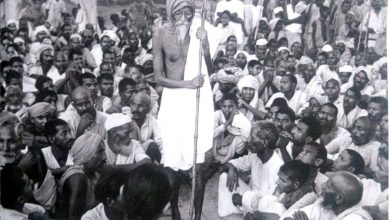
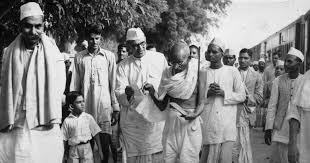
Mahatma Gandhi is remembered as the moral force behind India’s freedom struggle, but rarely as a constitutional thinker. Yet, in 1931, at the Karachi Session of the Indian National Congress, Gandhi moved a resolution that clearly defined what freedom should mean for ordinary Indians—not just political independence, but civil liberties, social equality, and economic justice. Known as the Karachi Resolution, this document later shaped the very structure of India’s Constitution. This article revisits that resolution to understand why it was revolutionary, how it influenced constitutional drafting, and why Gandhi’s role in shaping India’s democratic vision deserves more attention today.

By Ram Dutt Tripathi
In March 1931, at the Karachi Session of the Indian National Congress, a resolution was adopted that went far beyond routine political declarations.
Moved by Mahatma Gandhi, the Karachi Resolution on Fundamental Rights and Economic Policy offered a comprehensive vision of what independence should mean for India—not merely freedom from colonial rule, but the creation of a democratic state grounded in civil liberties, social equality, and economic justice.
Unlike many contemporary nationalist documents, the Karachi Resolution did not postpone questions of rights and welfare until after independence. Instead, it asserted that the moral legitimacy of Swaraj itself depended on how it transformed the lives of ordinary Indians.
In doing so, it laid down an intellectual and ethical foundation that would later find concrete expression in the Constitution of India.
Core Ideas of The Karachi Resolution
The resolution opened with a clear statement explaining why such a declaration was necessary:
“This Congress is of the opinion that to enable the masses to appreciate what ‘Swaraj,’ as conceived by the Congress, will mean to them, it is desirable to state the position of the Congress in a manner easily understood by them. In order to end the exploitation of the masses, political freedom must include real economic freedom of the starving millions.”
This sentence fundamentally redefined freedom. Swaraj was not to be a transfer of power from British rulers to Indian elites, but a transformation of social and economic conditions for the masses.
The resolution then articulated a set of Fundamental Rights, declaring:
“Every citizen of India has the right of free expression of opinion, the rights of free association and combination, and the right to assemble peacefully and without arms, for purposes not opposed to law or morality.”
It further affirmed:
“Every citizen shall enjoy freedom of conscience and the right freely to profess and practise his religion, subject to public order and morality.”
In addition, the resolution committed the Congress to:
• Equality before the law
• Non-discrimination on grounds of religion, caste, creed, or sex
• Protection of minority languages, cultures, and educational institutions
• Removal of social disabilities, including untouchability
Together, these provisions formed one of the earliest systematic articulations of a rights-based democratic state in colonial India.
Gandhi’s Speech: Explaining Swaraj to the Poor
When introducing the resolution, Gandhi was very clear about its intended audience. It was not designed for constitutional experts or future legislators alone. He stated that the resolution was meant for:
“those who are no legislators, who are not interested in intricate questions of constitution.”
In another remark, Gandhi clarified its deeper purpose:
“This resolution is intended to indicate to the poor, inarticulate Indian the broad features of Swaraj or Ramarajya.”
For Gandhi, constitutional principles had no meaning unless they could be understood by the poorest citizen. Swaraj had to be translated into guarantees of dignity, security, and justice in everyday life. This insistence on mass-oriented constitutional thinking was revolutionary in an era when constitutions were typically elite-driven documents.
Why the Karachi Resolution Was Revolutionary
1. Freedom Defined as Social and Economic Justice
Most anti-colonial movements of the time concentrated on political sovereignty. The Karachi Resolution insisted that political independence without economic justice would be hollow. By linking Swaraj to living wages, labour rights, peasant protection, and state responsibility, the Congress transformed nationalism into a promise of social transformation.
2. Civil Liberties Before Independence
At a time when colonial rule relied heavily on censorship, sedition laws, and preventive detention, the resolution envisioned a future Indian state constitutionally bound to protect freedoms of speech, association, and religion. This was a declaration that the new state would be limited by law, not driven by arbitrary power.
3. Universal Adult Franchise as an Ethical Principle
The demand for universal adult franchise—irrespective of caste, gender, or property—was radical even by global standards. Gandhi treated political equality not as a gradual concession, but as a moral foundation of democracy itself.
4. Abolition of Untouchability as State Duty
While social reformers had long criticised untouchability, the Karachi Resolution made its removal a political and constitutional obligation. Social equality was no longer merely a moral aspiration; it became a responsibility of the future state.
5. An Economic Vision Ahead of Its Time
The resolution supported:
• Living wages and humane working conditions
• The right of workers to organise
• Protection of small and cottage industries
• State ownership or control of key industries and natural resources
• Measures to reduce economic inequality
This anticipated a mixed economy and welfare-oriented state well before such ideas became globally dominant.
Influence on the Indian Constitution
The intellectual imprint of the Karachi Resolution is clearly visible in the structure of the Indian Constitution.
Fundamental Rights
• Freedom of speech and assembly → Article 19
• Equality before law → Article 14
• Non-discrimination → Articles 15 and 16
• Abolition of untouchability → Article 17
• Minority cultural and educational rights → Articles 29 and 30
Directive Principles of State Policy
• Living wages and humane working conditions → Article 43
• Social and economic justice → Articles 38–41
• State control of resources for the common good → Article 39(b)
• Reduction of inequality → Articles 38–47
The Constitution thus carried forward Gandhi’s insistence that democracy must balance liberty with justice and rights with social responsibility.
Why Gandhi’s Constitutional Role Is Often Underplayed
Gandhi’s contribution to constitutional thinking is frequently overlooked for several reasons. Legal histories tend to focus on the Constituent Assembly debates and formal drafting processes, sidelining the ideological groundwork laid earlier. Gandhi also expressed constitutional ideas in ethical and popular language rather than legal terminology, making his role less visible in technical narratives. Finally, his image is often confined to protest and moral leadership, obscuring his sustained engagement with questions of governance and institutions.
Conclusion
The Karachi Resolution of 1931, adopted by the Indian National Congress under Gandhi’s leadership, remains one of the most visionary political documents in modern Indian history.
It defined freedom not merely as independence from colonial rule, but as the guarantee of dignity, equality, and economic justice for all citizens. Its influence on the Fundamental Rights and Directive Principles of the Indian Constitution is unmistakable.
Recognising Gandhi as a constitutional visionary does not diminish the contributions of later drafters; instead, it restores historical continuity to India’s democratic project. Gandhi did not merely lead a movement—he articulated a moral blueprint for a republic that continues to challenge India to live up to its founding promise.
( With input from AI tool Chat-GPT)