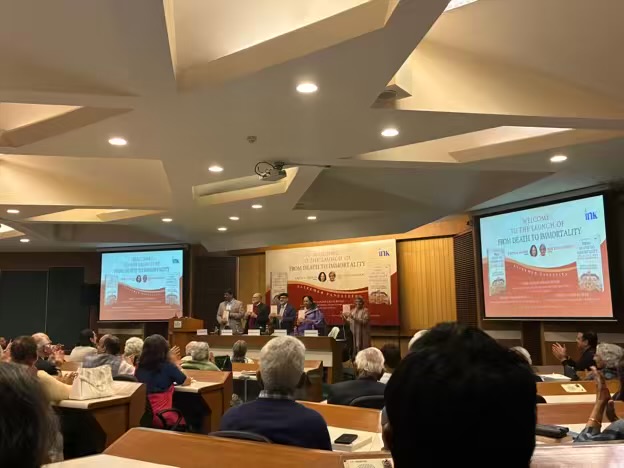
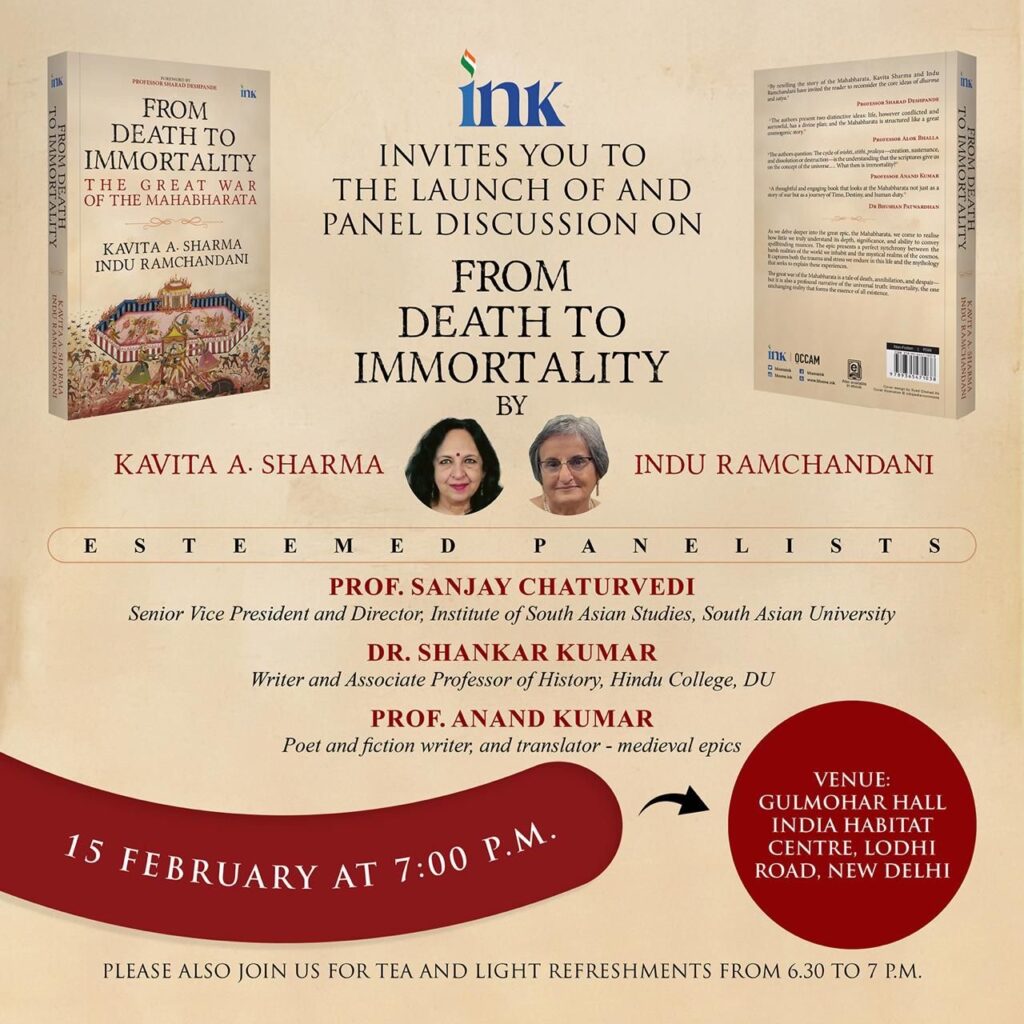
At the launch of the book “From Death to Immortality: The Great War of Mahabharata”, noted scientist and thinker Prof. Anand Kumar (MD, FAMS) offered a deeply reflective address that bridged epic philosophy with contemporary human concerns. His speech explored the eternal questions raised in the Mahabharata—about karma, death, rebirth, and moksha—while appreciating the literary depth of the authors, Prof. Kavita Sharma and Madam Indu Ramchandani.
Media Swaraj presents the full text of his thought-provoking speech, which examines how the epic war of Kurukshetra continues to illuminate the human quest for meaning, justice, and immortality.
The Lord of Life and Death
This book, ‘From Death to Immortality: The Great War of Mahabharata’, by Prof. Kavita Sharma and Madam Indu Ramchandani, is an extraordinary reflection on the epic in recent decades. It reads like a modern Purana. It demonstrates the authors’ great literary flairexpressed in easy language. The writing has a poetic and feminine quality. Images pop out as if you were opening a New Year greeting card—Krishna, Rishis, warriors, gods and battlefield pop out from the pages. The images are visualand easy to perceive without strain.
This book contains the summary of the epic. You do not need prior knowledge. BlueOne Inchas published it aesthetically.
Coming to the contents: the central question of human life is:
1. Why do good men suffer, and evil ones prosper?
2. What happens to unfulfilled obligations and desires? Do they end with life?
Lokayats, Charvaks, hedonists, Epicureans, or materialists have been known since the Vedic times. They believed all events in human life area matter of chance. They were not worth inquiring because:
1. There is only one life—who has seen the other?
2. Knowledge is acquired only by the senses. What is not known by the senses does not exist and is only an imagination.
3. soul, who has seen it? If it isthere, it is coexistent with the body and perishes with the body,
4. Ethics has no value because even ethical men suffer. Therefore, might isright, and finally,
5. Pleasure and suffering are a matter of luck or chance.
Importance of Ethics in Life
The Vedas also believed in the pleasures of life, here, upon earth and hereafter in heaven. Pleasure depended upon good karmas or deeds, including yajnas seeking favours from Gods by making offerings to them—a give and takerelationship. Bad karma and neglecting yajnas led them to hell after death. Therefore, ethics became very important in their lives.
Rebirth was accepted. Unexplained misfortunes or good tidings were because of unrewarded or unpunished karmas in a past life, which one does not remember in the present life. This accounted for the central question in the human mind: why do good men suffer and evil ones prosper?
The concept of Moksha
The Upanishads, the final portions of the Vedas, introduced the concept of Moksha, the transcendence of life, death, and rebirth. Rishi Sanat-Sujat, in the Udyog Parva, states that those who believe in and seek the tangible fruits of their actions go to heaven or hell. Those who sought the greater ideal of liberation preparedthemselves for Moksha through Nishkama Karm without the desire of its fruit.
The Mahabharata war took place in 3162 BC , according to the text and the astronomical events it cites to date itself. It was written in great detail by Krishna Dvaipayan, popularly known as Veda Vyasa.
Those days, the battlefield was not only occupied by warriors fighting to uphold their version of truth and morality, and their ideas of Dharma, but also by priests administering last rites, consoling the dying ones and their aggrieved relatives, including highborn women, sages delivering sermons on reality and truth, as well as hopeful vultures in the sky and jacals feasting over human relics. So, the war was an enterprise by warriors from both sides, for gaining heaven, in a far quicker way than the ascetic’s penance over years and lives.
Gita of Krishna
The battlefield was also the nucleus of spiritual evolution; relief from the old burden, the development of a new cognitive awareness and spiritual ideal, and their propagation. The Gita of Krishna was the supreme jewel that emergedon the battlefield of Kurushetra.
One may even find contradictory narratives by the sages and philosophers of different schools in the Mahabharata. But that is always so because the perception of Reality, the Infinite, is diverse according to the viewer’s eye span.
The Pearls of Wisdom from the Book
1. Creation began with deathlessness. Many deathless beings, divinities and prophets are mentioned in the scriptures of different faiths.
Brahma created beings of the mind, who in turn created beings of material bodies through sexual reproduction. But new beingsdid not die; they overloaded the earth and overtaxed its resources.
2. To address the problem of overpopulation, Creator, embodied as Brahma, created a daughter, Mrityu or Death, from his sense organs. Mind you, sense organs. Death is very much linked to the senses and can be overcome by controlling them. Mrityu was reluctant to undertake this horrible job and fled to perform penance for a thousand years.
Returning to her father, she wept, shed tears, but finally had to yield to her father. The father accepted her conditions as given in the Dron Parv:
i. Brahma said: ‘Your tears I took in my hands, but some fell on earth. They will become diseases born from the bodies of living beings, who will cause their own death, not you. Don’t fear. You will be doing no adharma (Dron Parva 54: 40).’
ii. Brahma agreed to her other conditions: ‘All living beings will cause their own death. Death does not kill them with a stick in her hand (DP: 54:50).’
iii. ‘Greed, anger, talking ill of others, envy and jealousy, ill-will, confusion of perception, shamefulness and harsh-words spoken—these will devour the bodies of those who are embodied (DP:54:38).
There were many such conditions which kill human life.
Yama:
Brahma gave Lokapalas, Yama, and the Diseases to assist her. Yama was responsible for biological death; he separated life and soul from the body and placed them in their karma-earned realms.
The Lord of Karmas:
A parable in which a cobra kills the young child of a widow and a hunter captures it for killing in the Stree Parvexplains the hierarchy of the Lordship of death, with the serpent serving only as the material cause. The serpent was inspired by Mrityu. Kaala, or Time, determines the duration of a life and its completion. Time lords over Mrityu. Karma rules Kaala. Therefore, the final cause of the end of a life is Karma. Man is the lord of his karmas. The child was responsible for its death and not the serpent.
But what if a man dissolves his Karma, or divine grace does it? He transcends karmas and becomes their lord. Death, now obeys his command. Such a person is Jivan-Mukta. His actions on earth are not counted as karma, as they are Nishkam (disinterested); they have no personal motive; they are an expression of truth, or divine consciousness. A Jivan-Mukta can leave his body at will or even transform it into a non-physical body of consciousness, immune to death. The body stays; the matter sublimates from it.
One can set all philosophy aside and just behold the attributes of such a Jivan-Mukta, the ideal man. His conduct and actions are so endearing and inspiring that, irrespective of the knowledge and the philosophy of Karma, soul and rebirth, one would like to adore and emulate him and become like him. Buddha did it, ignoring the soul and God.
I have not discussed the Gita. The authors have written about it too, in the book.
In the end, I congratulate Prof Kavita ji and Madam Indu ji for this marvellous book. I have already spoken about what I have learnt from the last chapter of the book.
Please also read this article
——————–
Speech by : Prof Anand Kumar, MD, FAMS, Former Senior Professor and Head, Department of Reproductive Biology, All India Institute of Medical Sciences, New Delhi
& Former National Fellow, Indian Institute of Advanced Study, Shimla